

I want to tell you about the night I sat on my bathroom floor at 1am, three weeks before my first solo trip, googling “how to plan a trip step by step” like the internet was going to reach through the screen and hold my hand. It didn’t. But eventually I figured it out, badly, one mistake at a time, and that’s why this exists.
Start With Your Trip Goal (Not the Destination)
Here’s the thing nobody tells you. I didn’t cry because I was scared of flying. I cried because I had forty browser tabs open, each one a different city, and I had no idea which one was “right.” I kept refreshing “best places to travel” lists like the answer was hiding in tab thirty-one.
It wasn’t. The answer was never in the destination. It was in a question I hadn’t asked myself yet.
Where should I go?
That’s the question everyone starts with. It feels natural. It’s also the wrong first question, and it’s the reason so many trips get planned twice, once in a panic and once for real.
Here’s the question that actually gets you somewhere.
What kind of experience do I want?
I didn’t ask myself that the first time. I picked Lisbon because a friend posted a photo of a yellow tram and it looked nice. Three days in, I realized I wanted quiet mornings and slow food, and instead I’d booked myself into a hostel next to a nightclub because it was cheap and close to “everything.” I hadn’t decided what “everything” meant to me. I just knew I wanted to go somewhere.
That gap, between wanting to travel and knowing what you actually want from the trip, is where most of the stress lives. Not in the flight booking. Not in the passport. Right here, at the very start, before you’ve spent a dollar.
So before you open a single flight search tab, sit with this for a minute. What are you actually craving right now? Not what looks good in photos. What do you need.
Maybe it’s rest. You’re depleted, work has been a lot, and you want to sleep past nine and not talk to anyone before noon.
Maybe it’s adventure. You want your heart rate up. You want a story that starts with “so this one time.”
Maybe it’s food and culture. You want to eat something you can’t get at home and stand in a market that smells like a different country.
Maybe it’s nature. Trees, water, silence, a trail that goes somewhere.
Maybe it’s luxury, and you’re tired of being tired, and you want someone else to make the bed for once.
Maybe it’s budget travel, because the point isn’t the five star hotel, it’s that you’re going at all.
Maybe it’s solo travel, because you need to know you can do something entirely on your own terms.
Maybe it’s a family vacation, and the real goal isn’t sightseeing, it’s everyone in one place, off their phones, laughing at the same joke.
Or maybe it’s romantic, and you just want to remember what it felt like to hold hands somewhere new.
None of these are wrong. But they point you toward completely different trips. A rest trip and an adventure trip do not belong in the same city, sometimes not even in the same country. I learned that the hard way in Lisbon, wanting rest and booking chaos.
Here’s a small exercise, and I know exercises can feel a little much when you’re already overwhelmed, so keep it short. Grab your phone, open a blank note, and write one sentence. Not a list. One sentence. “I want a trip that feels like _.” Fill in the blank honestly. Not what would look good if you posted about it. What would actually make you exhale.
Mine, if I’d done this before Lisbon, would have been “I want a trip that feels like nobody needs anything from me.” Instead I booked a trip that felt like a party I hadn’t been invited to plan.
This is the part where I’d normally tell you it gets easier from here, and it does, but I want to be honest about something first. Defining what you want doesn’t remove the fear.
You’ll still wonder if you’re choosing right. What it does is give you a filter. Every decision after this, the destination, the dates, the hotel, the itinerary, gets run through this one sentence. Does this match what I said I wanted? If yes, keep going. If no, that’s useful information, not a failure.
This is the real starting point of how to plan a trip step by step, and it’s the one step every anxious-at-midnight guide skips because it doesn’t come with a checklist. It comes with a question. Answer it first, and the rest of this gets a lot less scary. That’s not a promise that it becomes easy. It’s a promise that you’ll stop planning in circles.
Let me walk you through the exact sequence I wish someone had handed me that night on the bathroom floor, the order to actually do things in, so you’re never staring at your phone wondering what step comes next.
The Trip Planning Decision Framework
Okay. Here’s the part I actually wish someone had texted me instead of a “have fun!!” the night before my flight.
After Lisbon, I did something a little obsessive. I wrote down every single decision I’d made, in the order I made them, and then I wrote down the order I should have made them in.
The two lists looked nothing alike. I’d booked a flight before I checked if my passport was even valid past six months.
I’d booked a hotel before I knew what the weather would be doing. I was making decisions out of order, and out-of-order decisions are what turn planning into panic.
So here’s the sequence. Not because it’s the only way to do it, but because it’s the way that stops you from having to undo things later.
- Set your budget. Before anything else. Not a vague number in your head, an actual figure you write down.
- Decide how many days you have. This shapes everything that comes after it.
- Choose the season. Weather changes prices, crowds, and what you’ll actually be able to do.
- Shortlist destinations. Two or three, not twelve. You already know what you want from step one, remember.
- Check passport and visa requirements. Do this before you fall in love with a destination that needs a visa you can’t get in time.
- Estimate total costs. Flights, stay, food, and the stuff nobody remembers until they’re standing in it.
- Book transportation. Flights or trains, whichever gets you there.
- Book accommodation. Now that your dates and transport are locked, this becomes easy instead of a guessing game.
- Build your itinerary. Loosely. We’ll get into why loosely matters a little later.
- Prepare documents. Print copies, save digital copies, know where both live.
- Pack. Last, not first, because your itinerary tells you what you actually need.
- Travel.
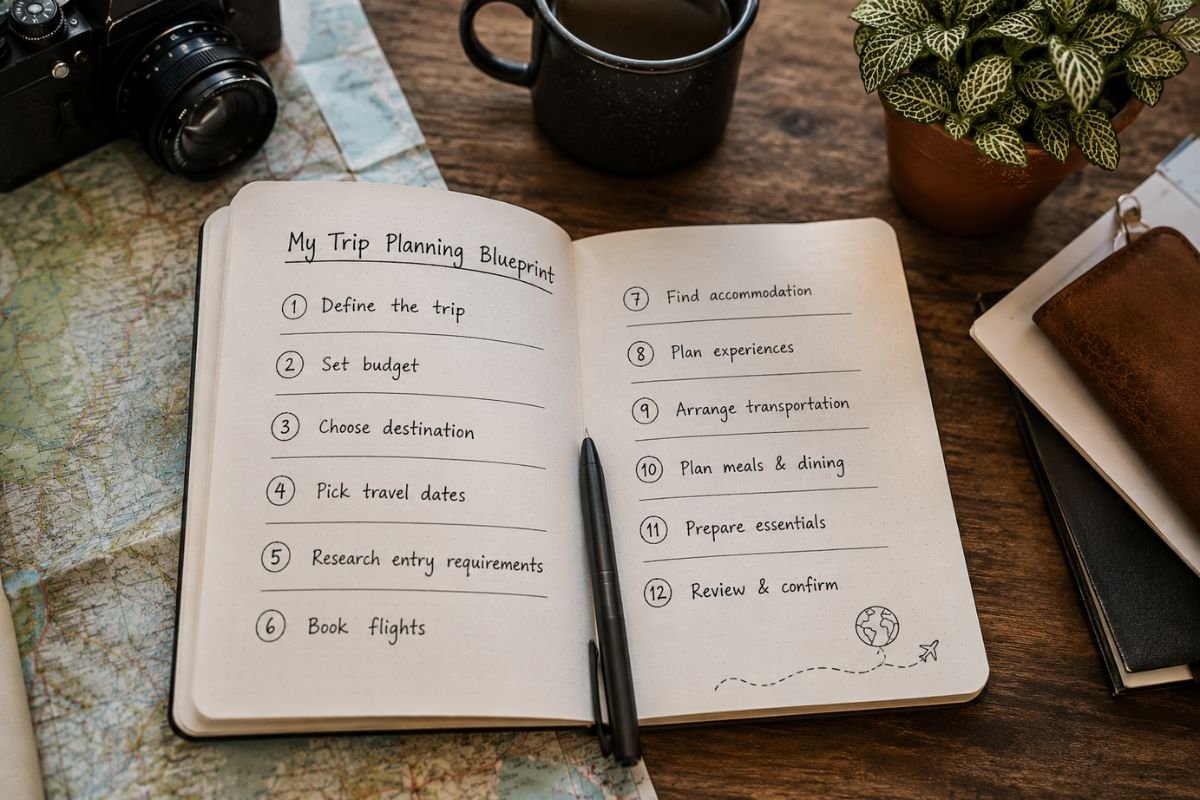
I know it looks almost too simple written out like that, twelve lines, done.
It doesn’t feel simple at 11pm when you’re staring at flight prices and a hotel tab and a passport that might expire while you’re mid-trip. But the order is the whole trick.
This is how to plan a trip step by step without the whiplash of realizing halfway through that you booked things backward.
Here’s the thing I got wrong, and I want to be specific about it because “be careful with the order” doesn’t mean much until you’ve felt the consequence.
I booked my flight to Lisbon on a Tuesday because the price dropped and I panicked and hit purchase. I checked my passport that Thursday.
It was fine, this time. But I’ve since heard from three different people in this community who booked flights and then found out their passport expired in four months, and some countries require six months of validity just to let you in.
They had to eat the cost of a flight they couldn’t use. That’s not a small mistake. That’s hundreds of dollars gone because the order was wrong.
So if you take one thing from this section, take the order. Budget, days, season, shortlist, documents, costs, transport, stay, itinerary, prep, pack, go. Screenshot it if you need to. Come back to it every time you feel that midnight-tab-spiral starting again, because it will happen more than once, and that’s normal.
Planning a trip isn’t a straight line for anyone, even people who’ve done it fifty times. The difference is they have a sequence to come back to instead of forty tabs and no floor to sit down on.
Next, we’ll get into the part that actually determines whether the rest of this feels doable or terrifying: the budget itself, and where the real costs hide.
Build a Budget That Reflects Reality
I want to tell you about the taxi from the airport in Lisbon, because it still makes me wince a little.
I’d budgeted for the flight. I’d budgeted for the hotel. I had not budgeted for the fact that it was almost midnight when I landed, the metro had stopped running, and the only way into the city was a taxi that cost more than my hotel did for the night.
I stood outside the airport doing math in my head, tired and a little panicked, watching my “budget trip” quietly stop being one.
That’s the thing nobody says clearly enough. A budget isn’t one number. “I have $1,500 for this trip” feels like a plan, but it isn’t, not yet. It’s a total with no shape. And a total with no shape is exactly how you end up standing outside an airport at midnight realizing you didn’t leave room for the thing that gets you to your hotel.
So break it down. Not because it’s fun, it isn’t, but because it’s the clearest way to see where the money’s actually going before you’re standing in it.
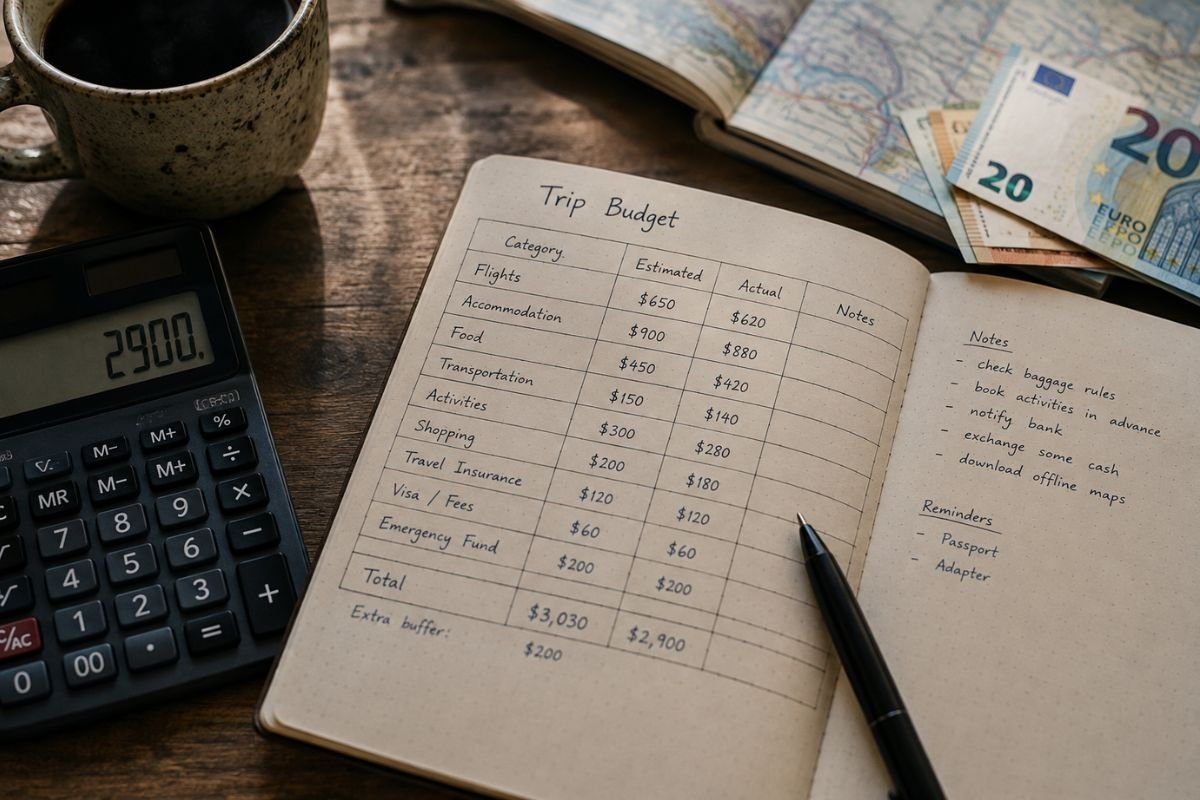
| Expense | Planned | Actual |
|---|---|---|
| Flights | ||
| Hotel | ||
| Local transportation | ||
| Food | ||
| Attractions | ||
| Shopping | ||
| Emergency fund |
Fill in the “planned” column before you book anything. Then, while you’re traveling, jot down the “actual” column, even roughly, even in a notes app at the end of each day. It sounds tedious.
It takes about 90 seconds a day. And it tells you exactly where your estimate was off next time, because it usually is, in the same handful of places.
Here’s where I’ve seen people, myself included, get it wrong over and over.
Airport transfers. You budget the flight, you budget the hotel, and you forget the thirty to sixty minutes in between them. That gap can cost anywhere from ten dollars to over a hundred, depending on the city and the hour. Look it up before you land, not after.
Baggage fees. That “cheap” flight isn’t cheap once you add a checked bag both ways. Some airlines charge for a bag not just there, but back too, and it’s easy to only price it one direction in your head.
Taxes and resort fees. The nightly rate you see on a booking site is rarely the number you pay. Cities add occupancy tax, hotels add service fees, and by the time you check out, that “$80 a night” room was closer to $95. It’s not a scam, exactly. It’s just a number they don’t lead with.
Currency conversion fees. If your card charges a foreign transaction fee, every single purchase quietly loses you a couple percent. Over a week, that adds up to a real dinner’s worth of money.
I wish someone had told me to build in a buffer, a real one, not an afterthought. Not five dollars tucked in the “just in case” category.
I mean ten to fifteen percent of your total budget, set aside and mentally already spent, so that when something goes sideways (and something always goes a little sideways) it doesn’t feel like the trip is falling apart. It just feels like you planned for a human trip instead of a perfect one.
Because here’s the truth under all of this. A budget that “reflects reality” isn’t about spending less. It’s about not being surprised.
The stress of overspending is rarely about the money itself. It’s about the moment you realize you didn’t see it coming. Build the buffer, fill in the table, and give yourself permission to be a little imprecise. You’re not running a business.
You’re trying to get through an airport at midnight without your stomach dropping.
Now let talk about destination itself as we move on, and why the goal isn’t finding the “best” place to go. It’s finding the right place for you.
How to Choose the Right Destination
A friend of mine, Priya, texted me last year asking where she should go for her first trip alone. I sent her three questions instead of a city name, and she was a little annoyed with me, I think. She wanted an answer, not homework.
But “where should I go” is a question with no right answer, because it depends entirely on a person the question doesn’t mention: you. The best trip for someone who wants to disappear into a museum for six hours is a bad trip for someone who wants to be moving the whole time. Neither person is wrong. They just need different places.
So instead of a list of cities, here are the questions I’d actually sit with, the ones that would have saved me from Lisbon’s nightclub hostel if I’d asked them first.
Do you dislike crowds? Be honest. Not “I can handle it,” actually think about how you feel in a packed square with vendors shouting and no personal space. If that drains you, a quieter destination in shoulder season will serve you better than a “top ten” list ever will.
Do you prefer warm weather? This sounds obvious until you’re booking a “dream trip” in December to somewhere that’s actually cold and rainy that time of year, because you never checked, you just knew the name of the place.
Are you comfortable driving abroad? Some places genuinely require it to see anything worth seeing. Some places you’ll never touch a car and everything runs on trains and your own two feet. Knowing which kind of trip you’re walking into changes almost every other decision.
Do you want museums or hiking? You don’t have to pick only one, but most trips lean one direction, and knowing which way yours leans tells you what kind of city or region actually fits.
Is this your first international trip? There’s no shame in that question, and there’s no shame in the honest answer either. A first international trip with a very walkable city, reliable public transport, and a lower language barrier will feel completely different from one where you’re figuring out three new systems at once. Give yourself an easier first swing if you’re not sure yet how you handle new places. You can go further next time.
Priya answered all three that I sent her. She didn’t like crowds, she wanted museums more than hiking, and it was her first trip alone. That ruled out two of the three cities she’d been eyeing before we even talked about flights. She ended up somewhere calmer than she originally wanted, and she told me afterward it was the first trip where she never once felt like she was performing “having a good time.” She was just having one.
That’s the part generic destination lists can’t give you. They’re written for everyone, which means they’re really written for no one. You are not “everyone.” You’re a person with actual preferences, actual limits, and an actual reason you wanted to go somewhere in the first place, the one you named back in the first section of this. Let that reason choose the city. Not a listicle. Not a friend’s photo of a yellow tram.
If Mexico’s on your shortlist, I’ve written a full breakdown of what that trip actually looks like solo, budget, safety, the parts nobody warns you about: the Mexico solo travel checklist.
Let now build out the timeline, so you know exactly what to do six months out, three months out, and the week before, instead of guessing.
Your Trip Planning Timeline
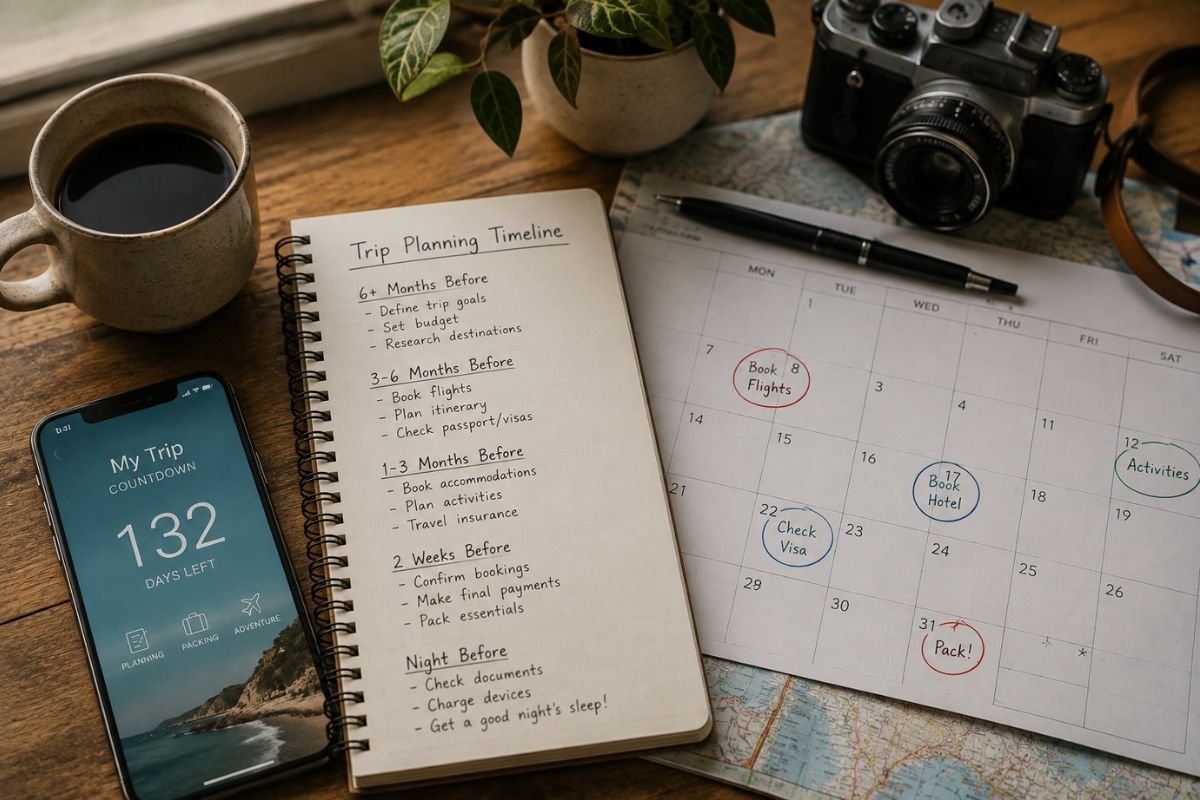
The scariest part of planning, for me, was never a single task. It was not knowing when I was supposed to be doing it. Was I behind by booking flights at the two month mark, or was that fine? Should I have applied for a visa already? Nobody hands you a syllabus for this. You just feel a low hum of “am I late” for weeks.
So here’s the syllabus. Not a rigid law, more like a rope to hold onto when the hum gets loud.
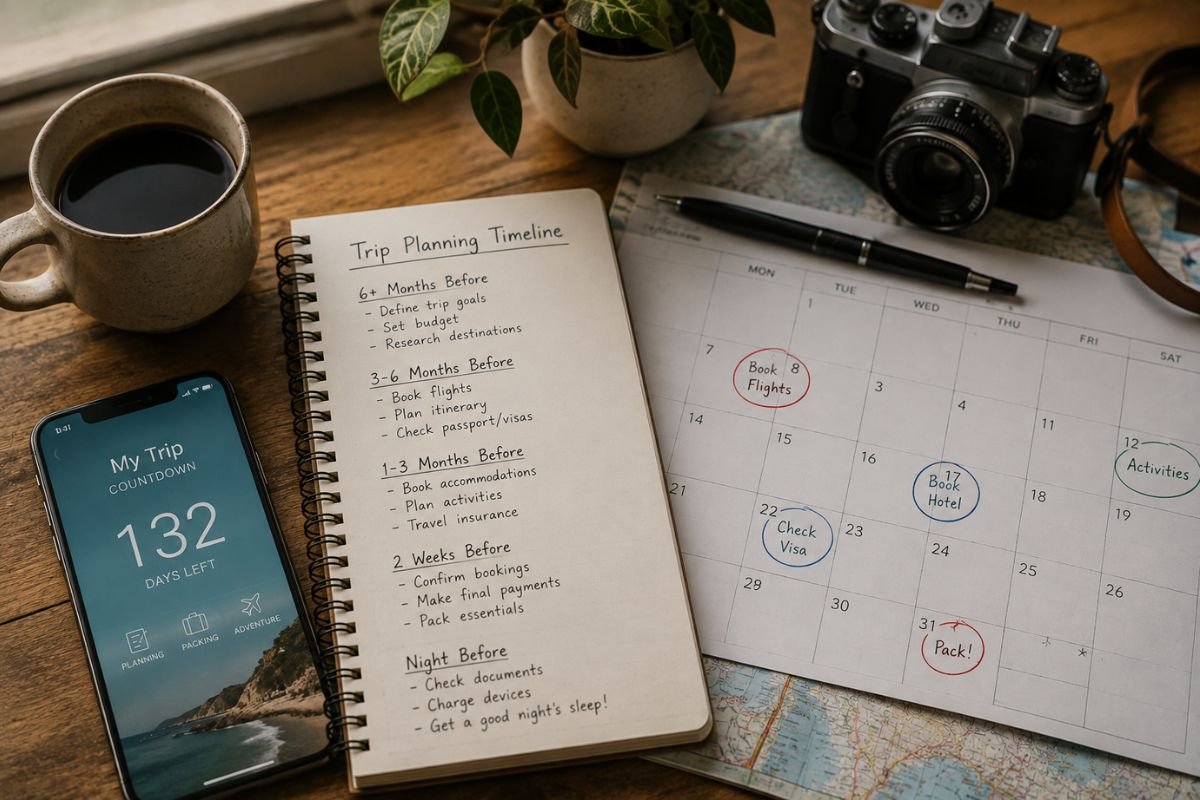
Six months before
Choose a destination, using the questions from the last section, not a photo you saw once. Check your passport expiration, and remember plenty of countries want at least six months of validity left on it, sometimes more. Estimate your budget using the table from earlier, even if the numbers are rough right now.
Three months before
Book your flights. Prices for most routes tend to settle into a reasonable window around here, not always the cheapest moment, but rarely the worst. Reserve your accommodations, now that your dates are locked. Apply for visas if you need one, because processing times are almost always longer than the government website makes it sound.
One month before
Plan your daily activities, loosely, we’ll talk about why loosely matters in the next section. Book tours or attractions that tend to sell out, the ones with limited daily entry or a real reputation for filling up. Arrange your airport transportation on both ends, so you’re not doing what I did outside that Lisbon airport at midnight.
One week before
Confirm every reservation. Not because they’re usually wrong, they usually aren’t, but because the one time they are wrong, you want to know now, not at the front desk. Download offline maps for wherever you’re going, since you cannot count on signal the second you need it most. Check the weather forecast, actually check it, not the general “it’s usually warm this time of year” you had in your head from six months ago.
One day before
Pack, using your actual itinerary as the guide, not a generic packing list built for a different trip than yours. Charge every device that’s coming with you. Complete your online check-in if your airline offers it. Prepare your travel documents, physical and digital, and know exactly which bag each one is going in.
Nobody mentioned that the anxiety doesn’t actually disappear once you hit each of these milestones. I thought once I booked flights, I’d feel calm. I didn’t, not really, I just traded “what if I don’t go” anxiety for “what if I forgot something” anxiety. That’s normal. The timeline doesn’t remove the feeling. It gives the feeling somewhere to land, a specific task instead of a shapeless dread.
There’s a real difference between “I’m anxious about this trip” and “I’m anxious because I haven’t checked the weather yet,” and the second one, you can actually do something about in the next five minutes.
Let talk about building your actual itinerary, and why the version that leaves room to breathe beats the one that’s packed tight every single time.
Build an Itinerary Without Burning Yourself Out
By day four in Lisbon, I hated myself a little. Not the city, myself. I’d built a spreadsheet before I left with a museum, a viewpoint, a food tour, and a day trip crammed into every single day, back to back, no gaps.
It looked impressive on paper. It felt like a punishment in real life. I remember sitting on a bench near the Alfama neighborhood, supposed to be at my next stop in eleven minutes, and just not moving. My body had quietly staged a revolt against my own itinerary.
Here’s the rule I use now, and it’s not complicated, which is sort of the point.
One major activity in the morning. The museum, the hike, the thing you actually came for.
One lighter activity in the afternoon. A short walk, a coffee somewhere with a view, something with no ticket time and no line.
Free time in the evening. Actual free time. Not “free time” that secretly means a fourth scheduled thing you wrote in a lighter font so it felt optional.
That’s it. Two anchors and a lot of open space. It looks almost lazy compared to the wall-to-wall spreadsheets you’ll see in other guides, the ones that map out every hour like a military operation.
I used to think those spreadsheets were the goal. They’re not. They’re a trap dressed up as preparation.
Overpacking an itinerary does two things, and both of them are bad. First, it turns your trip into a checklist, and checklists don’t leave room for the stuff you didn’t plan, the stuff that usually ends up being the best part.
The bakery you wandered into because you were early for something else. The conversation with a stranger because you weren’t rushing past them.
You can’t schedule those. You can only make space for them to happen. Second, it means one delay ruins your whole day. One line that’s longer than expected, one train that’s late, and suddenly you’re not “behind schedule,” you’re panicking, because every single slot after that was already full.
Here’s what took me way too long to figure out: “seeing everything” was never actually the goal, even though it felt like it at the time.
The goal was having a good time in the place I traveled to see. Those aren’t the same thing, and I didn’t understand the difference until I was exhausted on a bench, watching my “perfect” itinerary fall apart in real time.
So build loosely. Pick your one big thing each morning. Let the afternoon be soft. Protect your evenings like they’re sacred, because they kind of are, they’re where you actually process the day instead of just running through it.
You will not see everything. Nobody does, not even the people who’ve been going to the same city for twenty years. You’ll see enough, and you’ll actually remember it, instead of moving through a blur of your own making.
We’re getting into the section people always ask me about first: the twenty five mistakes first time travelers make, so you can skip most of them entirely.
The 25 Mistakes First-Time Travelers Make
I keep a note on my phone called “things I did wrong,” and every time I mess something up on a trip, I add to it. So does half the small community of first-timers I talk to. This list is theirs as much as it’s mine. Every single one of these came from an actual person standing in an actual airport thinking “I wish I’d known that.”
- Booking a flight before checking passport validity. The flight is nonrefundable. The passport rule isn’t negotiable.
- Ignoring baggage restrictions until check-in, then paying triple to fix it at the counter.
- Packing too many clothes “just in case,” and dragging a suitcase you can’t lift into a cobblestone street.
- Scheduling flights back to back with almost no layover margin, so one delay wipes out the whole trip.
- Exchanging all your money at the airport, where the rates are quietly some of the worst you’ll find anywhere.
- Forgetting to check local holidays, and arriving to find every museum and half the restaurants closed.
- Not saving copies of important documents, digital or physical, anywhere but the one bag that could get lost.
- Assuming your card will just work everywhere, and finding out at the register that it doesn’t.
- Not telling your bank you’re traveling, and having your card frozen the first time you use it abroad.
- Overbooking the itinerary, which we already talked about, and it’s still worth its own spot on this list.
- Underestimating how tired jet lag actually makes you, and scheduling something demanding for day one.
- Not learning even five basic phrases in the local language, which changes how people treat you more than you’d think.
- Wearing brand new shoes for the first time on the trip itself.
- Skipping travel insurance to save a small amount of money, and regretting it the one time something actually goes wrong.
- Not checking visa requirements far enough in advance, then scrambling under a deadline that didn’t need to exist.
- Assuming Wi-Fi will be available and reliable everywhere, and having no offline backup plan.
- Forgetting a universal power adapter, and finding out your devices are all dead with no way to charge them.
- Not researching tipping norms, which are wildly different from place to place and easy to get wrong in both directions.
- Carrying your passport around all day instead of a photo of it, and increasing the odds of losing the real thing.
- Booking a hotel purely on price, without checking the actual neighborhood it’s in.
- Not leaving a buffer day near the end of the trip, so a delayed flight home doesn’t cost you a day of work you didn’t plan to miss.
- Assuming a “24 hour” attraction or transit system runs exactly like it does back home, and getting stranded outside their actual hours.
- Trying to fit in one last activity right before heading to the airport, and nearly missing the flight because of it.
- Not telling anyone at home your full itinerary, in case something goes wrong and someone needs to know where you were supposed to be.
- Being too proud or too anxious to ask for help when you’re lost, when a local would have pointed you the right way in ten seconds.
Reading through that list, I want to be honest with you. I’ve personally made at least eight of them. Not read about, made. The exchanging money at the airport one still stings a little. But here’s what I’ve noticed after collecting these mistakes from other travelers too.
Almost none of them ended the trip. They made a day harder, or more expensive, or more stressful than it needed to be, but the trip kept going, and so did the person on it. That’s worth remembering when this list feels like a wall of everything that could go wrong. It’s not a wall. It’s a shortcut. Every item on it is a version of “you don’t have to learn this one the hard way, someone already did.”
Here are the part almost no travel guide talks about in real detail: what to actually do if something goes wrong.
8. Emergency Planning
A woman named Pricilia, who I met through this site’s comments section a while back, wrote to me about the time her bag got taken off a train in Italy. Passport, wallet, phone charger, all of it, gone in the ten minutes she looked away to help someone with directions.
She told me the scariest part wasn’t the theft itself. It was standing on the platform realizing she didn’t actually know what to do next. No plan, no backup, just panic and a very long train platform.
That’s why this section exists. Not to scare you. To make sure that if your version of Ana’s train platform ever happens, you’re not standing there blank.
If your passport is lost or stolen. Contact your country’s embassy or consulate in that country as soon as you realize it’s gone, they exist specifically for this and it’s a normal, common request, not an embarrassing one.
File a police report too, since some replacement processes require it. Having a photo of your passport’s information page, stored somewhere other than your bag, speeds this up enormously, which is why the next point matters so much.
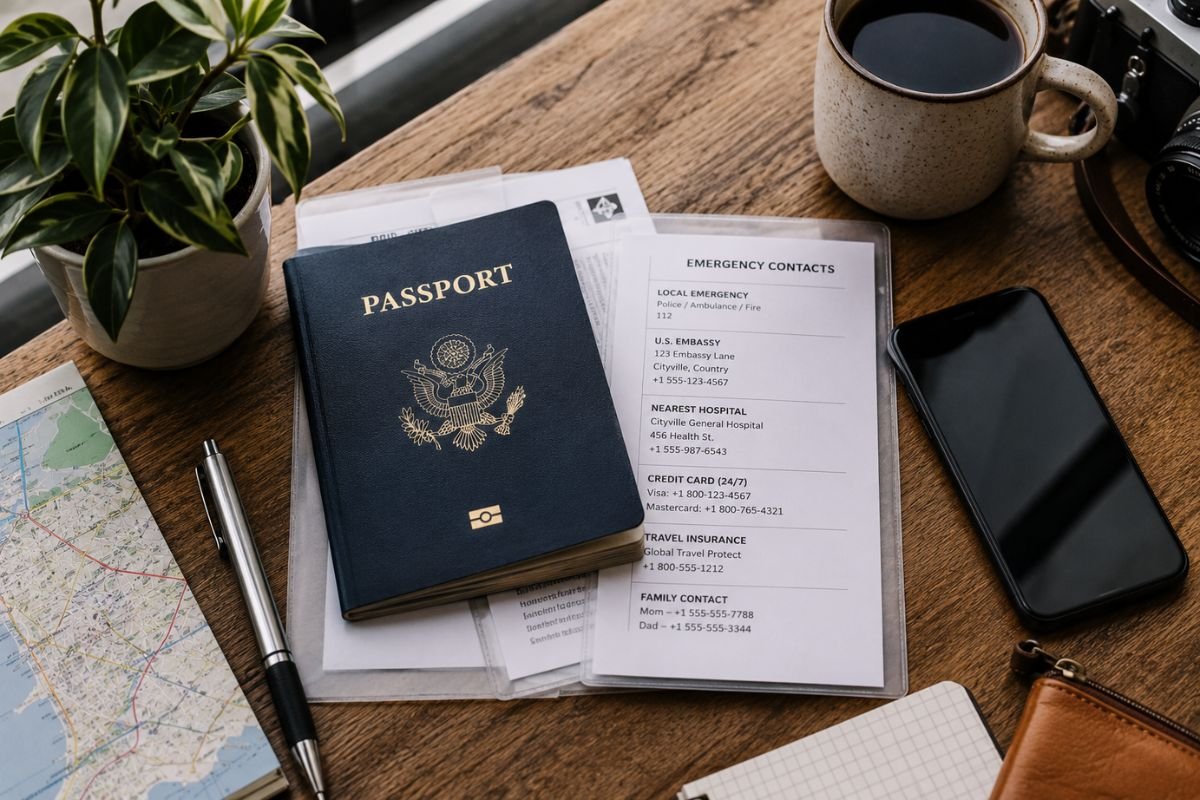
Emergency contacts. Before you leave, write down, somewhere accessible even without your phone, the number for your country’s nearest embassy or consulate at your destination, one emergency contact back home who knows your itinerary, and your travel insurance provider’s emergency line if you have one.
Not saved only in your phone. Written down, or emailed to yourself, so you can access it from any device.
Digital copies of everything. Passport, ID, travel insurance policy, hotel confirmations, flight details. Email them to yourself, or store them somewhere you can access from a browser on any computer, not just your own phone.
This sounds excessive until the day your phone is the thing that got taken, and suddenly it isn’t excessive at all, it’s the only reason you’re not starting from zero.
A simple emergency budget. Separate from your regular trip budget. A small amount of cash kept somewhere other than your main wallet, and a backup card tucked in a second, separate spot. If one gets lost or stolen, you’re not instantly stranded with nothing.
Sharing your itinerary with someone you trust. Not for permission. For safety. One person back home should know roughly where you’re supposed to be and when, so if something goes wrong and you can’t reach anyone, they know where to start looking and who to call.
Ana got through it, for what it’s worth. The embassy helped her get an emergency passport in about two days, her insurance covered the phone, and she finished the trip, a little shaken, with a much better story than she wanted. What she told me afterward stuck with me. She said the panic on the platform wasn’t really about the stuff.
It was about not having a next step. The moment she remembered she had a photo of her passport saved and her embassy’s number written down, the panic turned into a task list. Task lists, even scary ones, are so much easier to hold than fear with nothing to do about it.
You probably won’t need any of this. Most trips go fine, genuinely, statistically fine. But “probably won’t need it” is exactly why it belongs in a plan and not just in your head. Five minutes now, before you leave, buys you a version of yourself on that platform who isn’t blank. Who has a next step.
We can now start building the checklist for the night before you leave, the one you’ll come back to every single time you travel from here on out.
The Night-Before-You-Leave Checklist
There’s a specific kind of quiet that happens the night before a trip. The bag’s mostly packed, the apartment feels a little too clean, and your brain starts running the “did I forget something” loop on repeat, usually right as you’re trying to fall asleep. I still get it, every single time, even now. It never fully goes away. What’s changed is that I have somewhere to put that loop instead of just lying there with it.
So here’s the checklist. Go through it once, out loud if that helps, and let yourself actually check things off instead of just thinking about them.
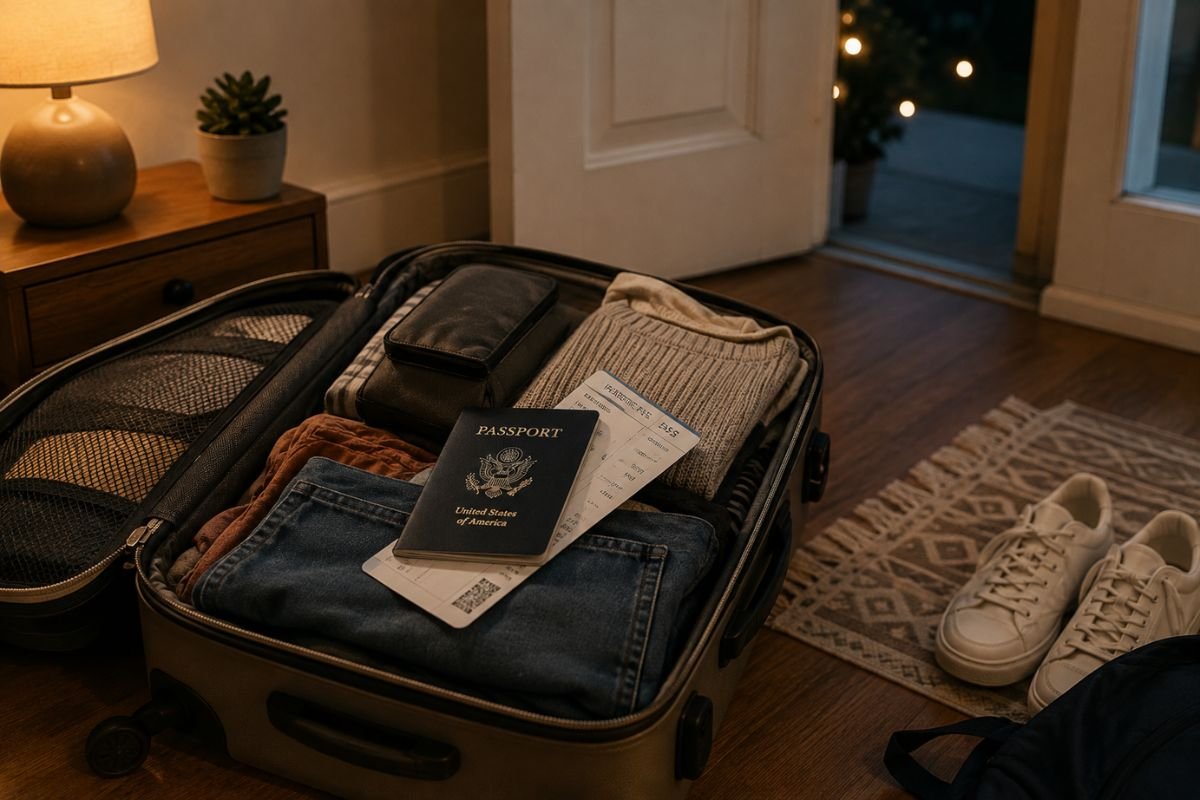
- Passport ready, and somewhere you’ll actually remember, not buried at the bottom of a bag.
- Wallet packed, with your emergency backup card somewhere separate from your main one.
- Phone charged, and your charger packed where you can reach it, not checked in a bag.
- Boarding pass downloaded, so you’re not relying on airport Wi-Fi at 5am.
- Weather checked, one more time, for the actual days you’ll be there.
- Luggage weighed, especially if you’re anywhere near the limit, because the airport scale is not the moment to find out you’re over.
- Home secured, whatever that means for you, locked doors, mail on hold, a light on a timer.
- Transportation to the airport confirmed, whether that’s a ride, a rideshare booked ahead, or knowing exactly which train to catch.
That’s it. Eight things. Not forty. Not a spreadsheet. Eight things you can actually hold in your head, or better, actually check off on a screen or a scrap of paper before you turn the lights off.
What took me a few trips to actually believe: the goal of a night-before checklist isn’t perfection. It’s permission. Permission to stop the loop. Once you’ve gone through it once, really gone through it, you’re allowed to close your laptop and go to sleep, even if some small anxious part of your brain wants to keep circling. You did the thing. The list is done. Whatever’s left is either genuinely out of your control tonight, or it’s small enough to handle tomorrow with coffee in your hand instead of at midnight in the dark.
Come back to this list every time you travel, not just the first time. I still use mine, years later, on trips that should feel routine by now. They still don’t, not entirely, and that’s fine. The list isn’t there because you’re bad at this. It’s there because a full brain deserves somewhere to set things down before it can rest.
Lastly, let’s put everything from this whole guide into one place you can actually save and use, so you’re never starting from a blank page again.
The Complete Printable Travel Planning Checklist
If you’ve read this far, you already have everything you need scattered across the last nine sections. This last one is just that, gathered into a single place, so you don’t have to scroll back through a long article the next time you’re three weeks out from a trip and your brain goes blank.
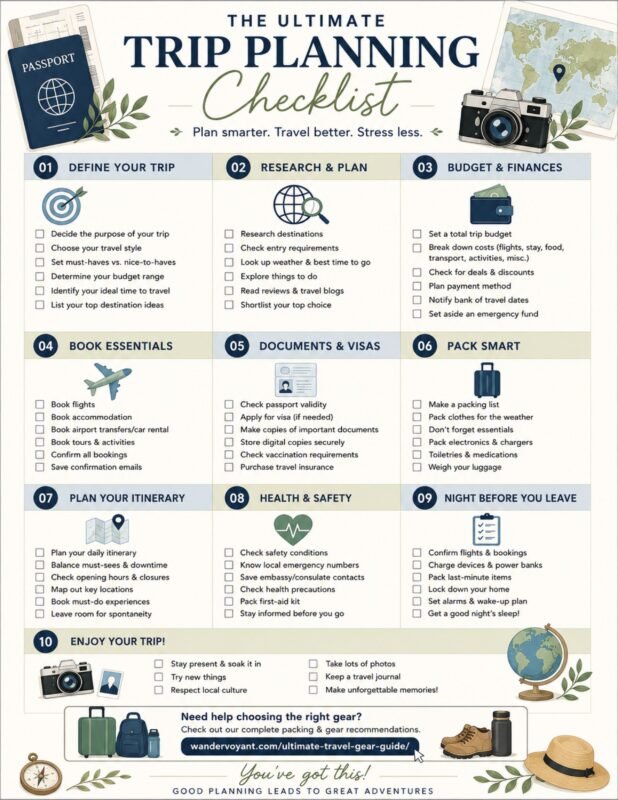
BBefore you book anything
- Write your one sentence: “I want a trip that feels like _.”
- Set your total budget and break it into categories.
- Decide how many days you have.
- Choose your season.
- Answer the destination questions and shortlist two or three places.
Six months before
- Choose your destination.
- Check your passport expiration.
- Estimate your budget using the category table.
Three months before
- Book flights.
- Reserve accommodations.
- Apply for any needed visas.
One month before
- Plan daily activities, loosely, one anchor per half of the day.
- Book tours or attractions that sell out.
- Arrange airport transportation both ways.
One week before
- Confirm every reservation.
- Download offline maps.
- Check the actual weather forecast.
Emergency prep, anytime before you leave
- Save digital copies of your passport, ID, and confirmations.
- Write down embassy and emergency contact information.
- Set aside a small emergency budget, cash and a backup card.
- Share your itinerary with someone you trust.
The night before
- Passport ready.
- Wallet packed.
- Phone charged.
- Boarding pass downloaded.
- Weather checked.
- Luggage weighed.
- Home secured.
- Transportation to the airport confirmed.
Save this. Screenshot it, copy it into your notes app, print it and stick it to your fridge, whatever actually means you’ll come back to it. This is the version of the guide that doesn’t need the stories or the explanations anymore. It’s just the shape of what to do, in order, the thing I wish had existed the night I was sitting on my bathroom floor with forty tabs open and no idea where to start.
You’re going to be okay. Not because nothing will go wrong, something probably will, in some small forgettable way. But because you now have a sequence to fall back on instead of a spiral. That’s really the whole difference between a trip that feels like it’s happening to you and one that feels like something you planned, on purpose, for yourself.
Planning a trip doesn’t have to be overwhelming. Download this beautifully designed one-page PDF to organize your budget, bookings, travel documents, packing list, itinerary, emergency details, and final pre-departure tasks, all in one place.
👇 Click below to download your free checklist.
🧳 Download the Free PDF Checklist
A Few Official Sources Worth Bookmarking
Everything in this guide comes from real experience, mine and other travelers’. But a few specific things, passport rules, carry-on limits, health recommendations, change from time to time, and they’re worth checking directly from the source rather than trusting a blog, including this one.
For passport validity and application timelines, the U.S. Department of State’s travel site is the actual source, not a summary of it. For what you can and can’t pack in a carry-on, TSA’s official rules page is updated directly by the agency that enforces it. And for destination-specific vaccines or health notices before an international trip, the CDC’s Travelers’ Health site is worth a look four to six weeks before you go, especially if you’re headed somewhere with specific recommendations.
None of these replace the plan you just built. They just make sure the plan is standing on accurate ground.
Frequently Asked Questions
Frequently Asked Questions
I’ve never traveled internationally before. Is this guide still for me, or is it too basic?
This guide was written for exactly that first trip. If anything, start here rather than with guides written for people who’ve already done this a dozen times. The order matters most when you’ve never done it before, since that’s when it’s easiest to get it backward.
How far in advance should I actually start planning?
Six months gives you the most breathing room, especially if you need a visa or want the best flight prices, but it’s not a hard rule. People plan solid trips in six weeks all the time. The timeline in this guide is meant to be compressed if you have less time, not abandoned.
What if my budget is really tight? Can I still use this system?
Yes, and honestly the budget table matters more, not less, when money is tight. Knowing exactly where a small amount of money is going prevents the kind of surprise expense that derails a tight budget completely. A tight budget just means the buffer percentage matters even more.
I’m scared of something going wrong and not knowing what to do. Is that normal?
Completely normal, and it’s exactly why the emergency planning section exists. Most people who feel that fear haven’t actually done anything wrong, they just haven’t built a plan for the “what if” yet. Once you have one, even a simple one, that specific fear tends to quiet down a lot.
Should I plan every single day of my trip in detail, or leave it open?
Leave more open than you think you should. One planned activity in the morning and one lighter thing in the afternoon, with real free time in the evening, tends to make trips feel better than a fully scheduled itinerary, even though the packed version looks more impressive on paper.
What’s the one thing people forget most often?
Passport validity requirements, easily. Most people check that their passport isn’t expired, but many countries require six months of validity remaining beyond your travel dates, not just that it’s technically still valid. Check this before you book a single flight.
I keep feeling like I’m forgetting something even after making lists. How do I get that feeling to stop?
Honestly, it might not fully stop, and that’s okay. The goal isn’t zero anxiety, it’s having somewhere to put the anxiety so it doesn’t just spiral with nowhere to go. The night-before checklist exists for exactly that feeling. Go through it once, out loud if it helps, and let yourself actually be done for the night.