Some links in this article are affiliate links. If you book through them, I earn a small commission at no extra cost to you. I only recommend tours I’ve taken myself.
This 7 day Madeira itinerary is built for people who refuse to make the mistake most visitors make: flying in, spending two days wandering Funchal, and flying home thinking they’ve seen the island. They haven’t. Not even close.
The tourists never make it past the capital and the one famous hike. Get past them and the island opens up. Ancient forests buried in fog. Lava pools with nobody in them. Bars where the poncha costs three euros and the owner pours heavy.
Seven days is the sweet spot. Five days can be like a rushed and ten starts to repeat itself. One week lets you hike the big trail, swim in the ocean, eat incredibly well, and still have time to just sit somewhere beautiful and do nothing.
This itinerary assumes it’s your first time on the island. It moves in a sensible loop, keeps the driving in reasonable chunks, and front-loads the hard hiking so you’re not saving the toughest day for when your legs are already gone.
One thing before we start. If you’re planning to book tours, do it two to three weeks ahead, especially between June and September. The popular hikes and boat trips actually sell out.
And one truthful warning before you go any further. If you want beaches and nightlife, go to the Algarve instead. Madeira is for walkers, eaters, and people who think a great day ends tired. If that sounds like you, keep reading.
Before You Go: The Stuff That Actually Matters
Getting there and around. You’ll fly into Cristiano Ronaldo Madeira International Airport, which everyone just calls Funchal airport. It’s about 20 minutes from the capital.
Rent a car. I know some blogs say you can do Madeira by bus, and technically you can, but the buses don’t go to trailheads, they don’t go to Fanal Forest, and they turn a 40 minute drive into a two hour ordeal. Get the car.
If you’re not used to steep, narrow mountain roads, pay the extra for an automatic. Your clutch foot will thank you by day three.
Download offline Google Maps before you leave Funchal. Mountain roads lose signal constantly, usually right when you need directions most. Ten minutes of prep saves an hour of guessing at unmarked forks.
When to visit. Here’s the honest answer: there isn’t a bad time. Madeira sits far enough south that it holds around 20 degrees Celsius even in January.
That been said, each season has a personality. Spring brings wildflowers and thinner crowds, and it’s my personal pick. Summer is peak season, busy but buzzing. Autumn has the warmest sea temperatures and the grape harvest. Winter is the secret season.
Cheap flights, empty levadas, and if you’re there over New Year’s, Funchal puts on a fireworks show that once held the Guinness World Record for the largest in the world.
One thing nobody warns you about: the weather. Madeira has a stack of microclimates and they all change their minds hourly. It can be sunny and 22 degrees at sea level while the peaks are socked in fog and cold enough for a jacket. Pack layers and always keep a light waterproof shell in your daypack.
I never travel without a packable down jacket. It weighs nothing, squishes into its own pocket, and I’ve worn it at the top of Pico do Arieiro in July.
Check the official trail status page at visitmadeira.pt the night before every hike in this itinerary. Madeira closes trails after landslides, sometimes for months, and there’s nothing worse than a 40 minute mountain drive to a locked gate.
While you’re there, check the current list of trails with a small entry fee, since several of the island’s headline hikes now require one bought online in advance. Both checks together take about five minutes.
Where to base yourself. Funchal is the obvious choice and honestly the right one for a first trip. The old town is walkable, the restaurant scene is the best on the island, and every tour in this article either starts there or will pick you up from there.
If quiet is more your thing, São Vicente on the north coast puts you right in the mountains, and Calheta in the southwest has the warmest weather and a proper sandy beach, which is rarer than you’d think on a volcanic island.
Now, the itinerary itself.
Day 1: Land in Funchal and Fall for the Old Town
Get in, pick up the rental car, drop your bags, and don’t plan anything ambitious. Jet lag plus Madeira’s vertical streets is a bad combination for a heavy first day.
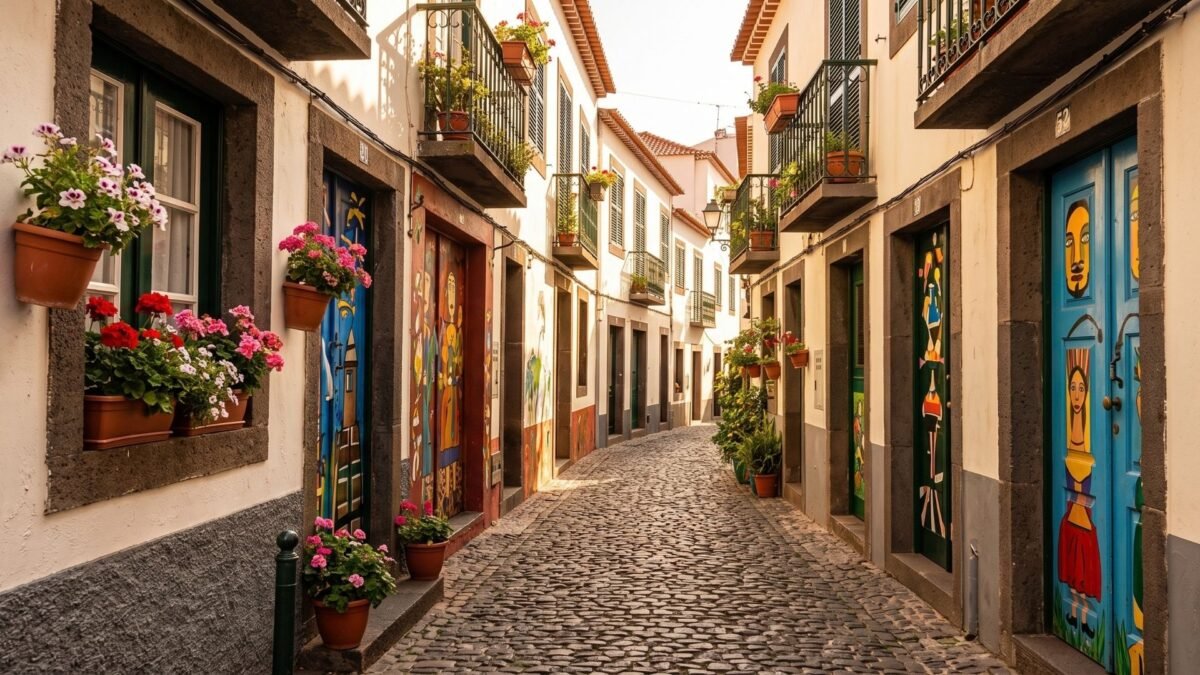
Head straight to Zona Velha, the old town, and walk Rua de Santa Maria. Someone had the brilliant idea years ago of inviting local artists to paint the old doors of the abandoned buildings, and now it’s an open-air gallery stretching up the street. Some are political, some are just beautiful, and all of them make for better photos than anything in a museum.
From there, wander into Mercado dos Lavradores, the farmers’ market. Go upstairs to the flower sellers first, where women in traditional dress sell bouquets for a few euros.
The ground floor fish market is where you’ll first encounter the island’s famously ugly espada, the black scabbard fish. It looks like something from a nightmare but tastes like something from a dream.
For dinner, order espada com banana, the local classic where the fish is served with fried banana and passion fruit sauce. It sounds strange. It works. Trust the island on this one.
Where to eat and drink: Skip the tourist traps on the main drag. Find a tiny poncha bar instead. Poncha is Madeira’s signature drink, made with sugarcane spirit, honey, and either lemon or orange juice, and the old town has holes in the wall where it’s been made the same way for decades. A word of warning: it goes down like juice and kicks like a mule. Locals sip it.
And since you have a rental car this week: the car stays parked on poncha nights. Taxis in Funchal are cheap, and Madeira’s mountain roads are not where you want to be after two ponchas.
Tour option: If you want someone to lead the way through the food scene, the Funchal food and wine tour is the one I’d book. Worth it if you only have one or two nights in the capital, because the guides know the poncha makers by name, and that buys you pours and stories you can’t get walking in cold.
Day 2: East Madeira, Santana and the Easiest Great Viewpoint on the Island
Today is the gentle day, and you’ll appreciate that by tomorrow morning.
Drive east along the VR1 motorway, about 45 minutes, to Santana. This is postcard Madeira. The village is famous for its palheiros, the little triangular houses with thatched roofs that look like they were designed by elves. A handful are open to walk through. Most are still people’s homes, so be respectful with the camera, but yes, take the photos.
From Santana, head inland to Ribeiro Frio, which translates to “cold river” and delivers on the name. This is one of the island’s main levada starting points. Levadas are the irrigation channels that crisscross Madeira, built over five centuries to carry water from the wet north to the dry south. They come with walking paths alongside them, and hiking them is THE thing to do on this island.
Today, do Vereda dos Balcões. It starts right in the village, and it’s the ideal warm-up for what’s coming.
Trail facts: Vereda dos Balcões
Trail Facts
| Distance | 3 km return (1.5 km each way) |
|---|---|
| Time | 1.5 hours total |
| Difficulty | Easy, almost flat |
| Parking | Roadside in Ribeiro Frio village, limited |
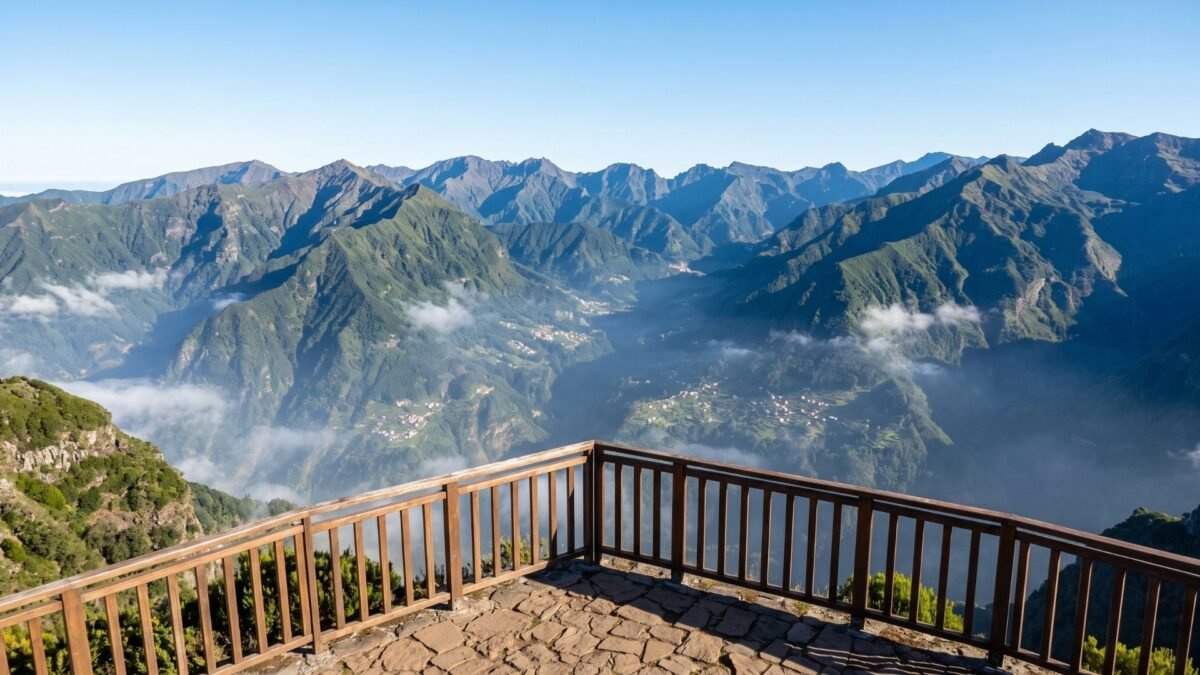
It’s short, gentle, and it ends at a viewpoint that looks straight down a valley at the island’s central peaks. On a clear day you can see both coasts at once. We were the only people at the rail when we went, and I still think about that view. It might be the best effort-to-reward ratio of any walk in Europe.
The one thing to know: Balcões gets swallowed by cloud most afternoons. Go before 11 AM or you’re walking to a viewpoint in a white room.
On the way back, loop through Machico, Madeira’s original capital, for a quiet dinner by the bay. It’s where the first Portuguese settlers landed in the 1400s, and it has a relaxed, local feel that Funchal sometimes lacks.
Day 3: Pico do Arieiro to Pico Ruivo, the Day You’ll Tell Everyone About
This is the reason you came to Madeira. Set an alarm. Leave by 6:30 AM. I know, you’re on holiday, but hear me out.
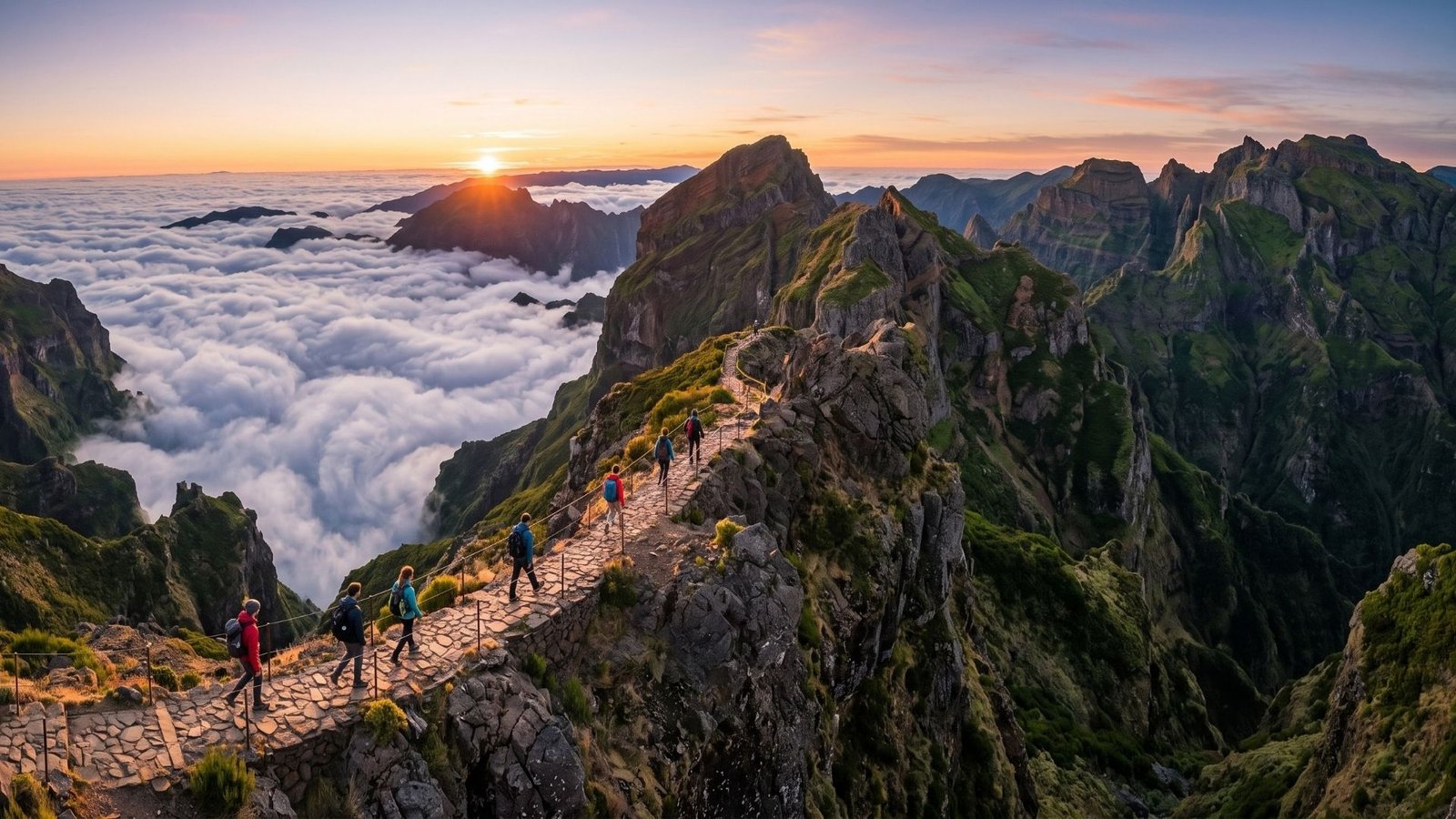
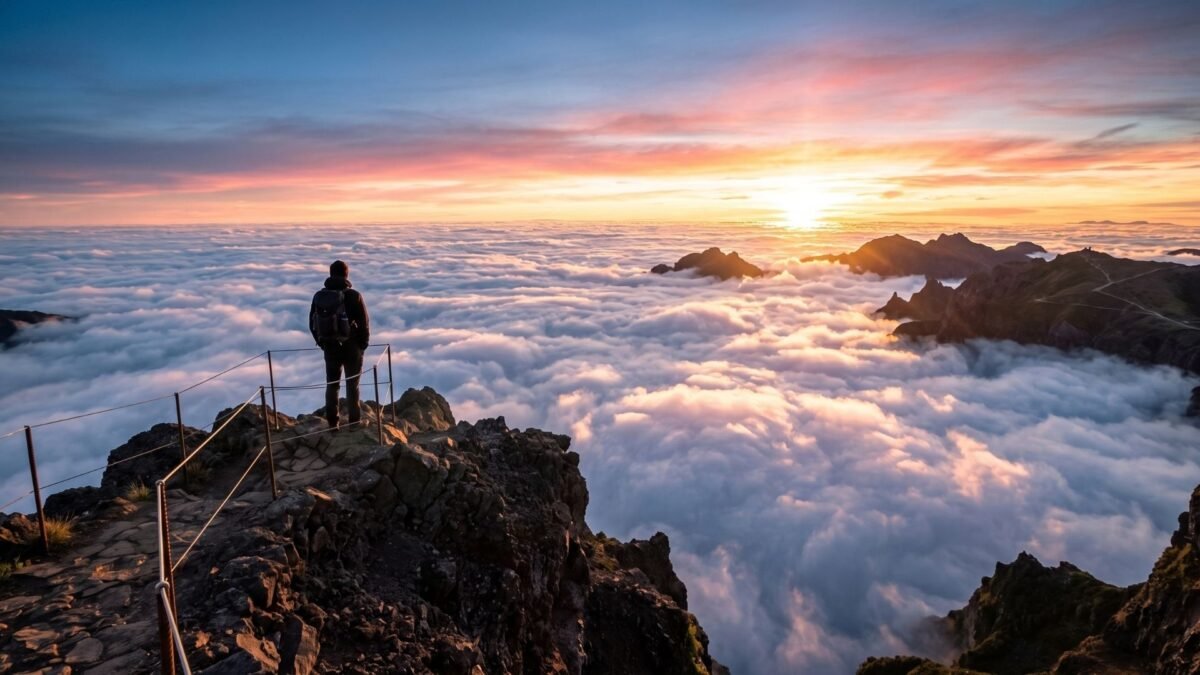
The trail starts at Pico do Arieiro, at 1,818 meters, the third highest peak on the island. Get there early enough and you’ll stand above a sea of clouds as the sun comes up, watching the peaks around you turn from grey to gold. It’s the best hour on the island. Coffee from the little cafe at the summit tastes better than any coffee has a right to.
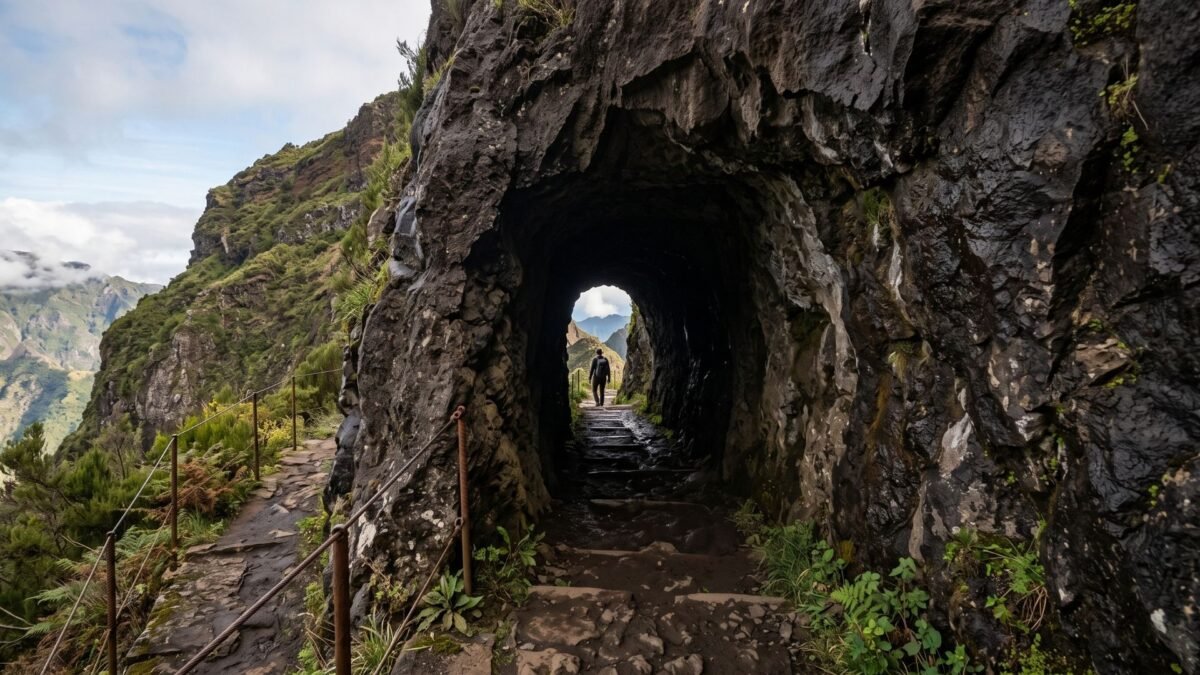
Then the real hike begins. The trail from Arieiro to Pico Ruivo, Madeira’s highest point at 1,862 meters, is stairs carved into volcanic rock, knife-edge ridges, and tunnels. Lots of tunnels.
And here is the thing nobody tells you until you’re standing at the entrance of the first one, realizing your phone flashlight isn’t cutting it. Several of these tunnels are completely, utterly, no-light-at-either-end pitch black. If you start at sunrise like you should, you’ll hit the longest ones in near total darkness, with sheer drops a meter to your left.
This is where I lecture you, because someone has to. Bring a proper headlamp. Not your phone. Not a keychain light. A real headlamp. I use the Black Diamond Astro 300.
It’s bright enough to see the path and the drop-offs, weighs almost nothing, straps to your head so both hands are free for the chains you’ll be gripping, and it cost me about twenty bucks.
I have carried it through tunnels in Iceland, the Dolomites, and three on Madeira before 8 AM on a Tuesday. Buy it before you fly, because the only thing available at the trailhead is regret.
One more gear note, and then I’ll stop being your mother. Those carved stone stairs get slick when damp, and on Madeira, damp is the default state of everything above a thousand meters.
Between November and March, strap on a pair of microspikes. They’re cheap, they fold smaller than a sandwich, and they turn sketchy staircases into normal staircases.
Trail facts: Pico do Arieiro to Pico Ruivo (PR1)
Trail Facts
| Distance | 10 to 11 km depending on your return route |
|---|---|
| Time | 5 to 6 hours |
| Difficulty | Moderate to hard (stairs, exposure, tunnels) |
| Parking | Free lot at Pico do Arieiro, fills by 8 AM in high season |
| Cost | Small per-person trail fee, bought online in advance |
This is also the trail most often affected by closures and diversions after rockfall, so the night-before status check matters more here than anywhere else on the island.
There are stretches where the path narrows to a meter wide with air on both sides. If that sentence made your palms sweat, book the guided Pico Ruivo trek instead.
They drive you to the far trailhead so you only hike the best one-way section, with a guide who knows every tunnel and viewpoint. Zero shame in that. The mountain doesn’t care how you got there.
No car for the sunrise start? Taxis from Funchal to Pico do Arieiro run about €30 to €40 each way, and most hotels will arrange one the night before. Cheaper and easier: the guided trek above includes the transfer, which is exactly why locals recommend it to visitors.
However you do it, when you finally stand on Pico Ruivo’s summit marker, with clouds boiling below you and the whole Atlantic glittering on both sides of the island, you’ll understand why people cry on this trail. It’s not the difficulty. It’s the scale.
Take the afternoon completely off. You’ve earned it. Pool, nap, long dinner. Your legs will be talking to you tomorrow.
Day 4: 25 Fontes, the Levada That Deserves Its Fame
Today is the famous one, and it earns every bit of the reputation. It’s also a proper drive, so treat this as a west-side day and set off early.
Levada das 25 Fontes, the levada of the twenty-five springs, starts at Rabaçal, tucked below the Paúl da Serra plateau in the island’s west. From Funchal it’s roughly an hour and a half by car, up onto the plateau and along the ER105.
Here’s the bit that catches people out: you can’t drive down to the trailhead itself. You park at the Rabaçal car park up on the road, then either walk the tarmac access road down (about 20 to 30 minutes, steeper than it looks on the way back up) or take the little shuttle van that runs up and down for a few euros. Factor that into your day either way.
From there the path follows the water channel through forest until it dead-ends at a cliff amphitheater where twenty-five springs pour out of the rock and converge into a lagoon.
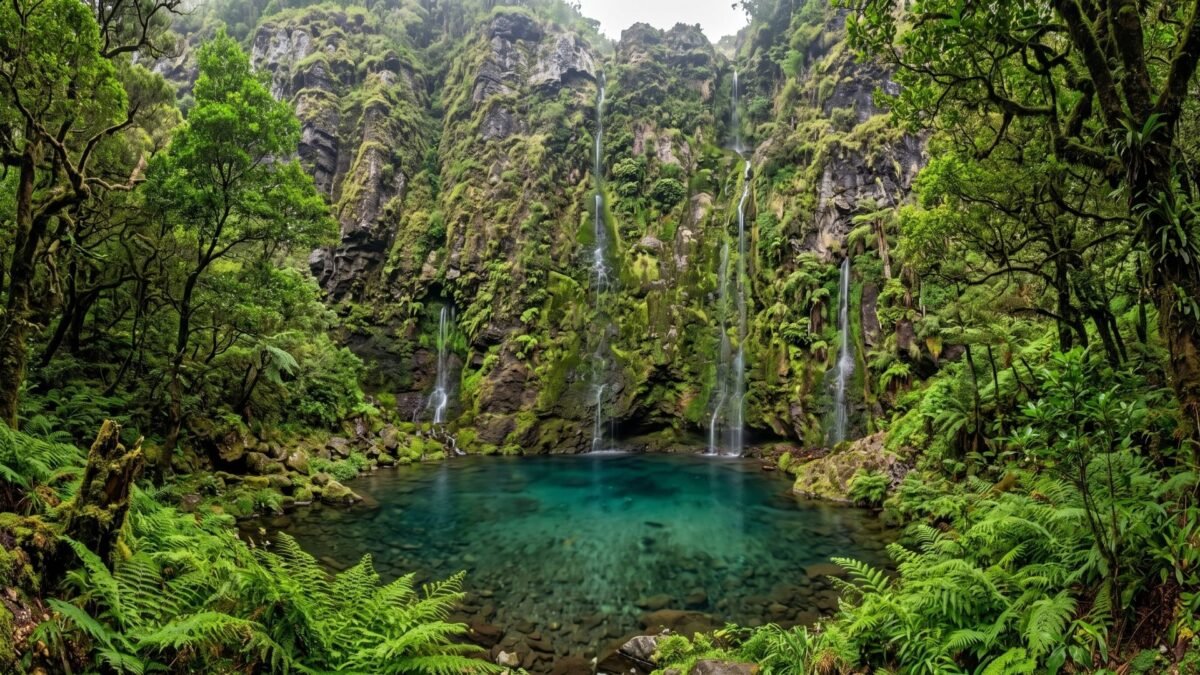
The water is startlingly cold. Swimming here has been restricted at times for safety and conservation reasons, so check the current rules and any posted signs at the lagoon rather than assuming.
Trail facts: Levada das 25 Fontes (PR6)
Trail Facts
| Distance | Around 11 km including the Risco waterfall spur and the access road |
|---|---|
| Time | 4 to 5 hours |
| Difficulty | Moderate (flat but narrow ledges and tunnels) |
| Parking | Rabaçal car park on the ER105, arrive before 9 AM |
| Cost | Small per-person trail fee, plus a few euros if you take the shuttle |
The route combines with the Levada do Risco spur for a second waterfall, which is why we budget the full morning. Flat doesn’t mean easy here. There are tunnels (headlamp, again, always the headlamp), narrow ledges, and sections where the path has crumbled to a foot’s width.
Timing is everything. Tour buses arrive around 10:30 and turn the trail into a conga line. Start before 9 AM or after 3 PM and you’ll have the forest to yourself, which is when it’s magical. Mist drifting through the trees, nothing but running water and birdsong.
Should you go guided? Honestly, for this one, maybe. The trail has unmarked forks, and people do get turned around in the woods up there. The guided 25 Fontes walk runs about €40 with hotel pickup, and the guides know exactly where the best angles are on the lagoon.
If you’re confident with trail navigation, go solo and keep the money. If you’re the type who gets lost in a supermarket, book the tour.
In the late afternoon, you’re already on Paúl da Serra, so don’t rush the drive home. Pull over on the plateau and stay for the light. It’s a strange, windswept flatland that looks more like Scotland than Portugal, and it catches ridiculous sunsets. Bring something warm. It’s always ten degrees colder up there.
Day 5: West Madeira, Lava Pools and the Forest From a Fairytale
Today you stay west, and the west is where Madeira gets weird and wonderful. You were up here yesterday, so if you’d rather cut the driving, consider moving to a night in São Vicente or Porto Moniz for days four and five and doing the whole west side from a northern base.
Take the VR1 west out of Funchal, then cut north and pick up the coastal ER101 towards São Vicente and Seixal. Roughly an hour and a quarter in, pull over at the Véu da Noiva viewpoint, where a waterfall pours off the cliff into the sea. It takes five minutes and you’ll take fifty photos.
Your main stop is Porto Moniz, at the island’s northwest tip. The natural swimming pools here were formed when lava hit the ocean and cooled into rock basins, and the town has turned them into the best swimming spot on the island. Salt water floods in with every wave, the pools are calm and clear, and entry is a few euros for adults, less for kids. Budget a couple of hours here minimum. We stayed three and had to drag ourselves out.
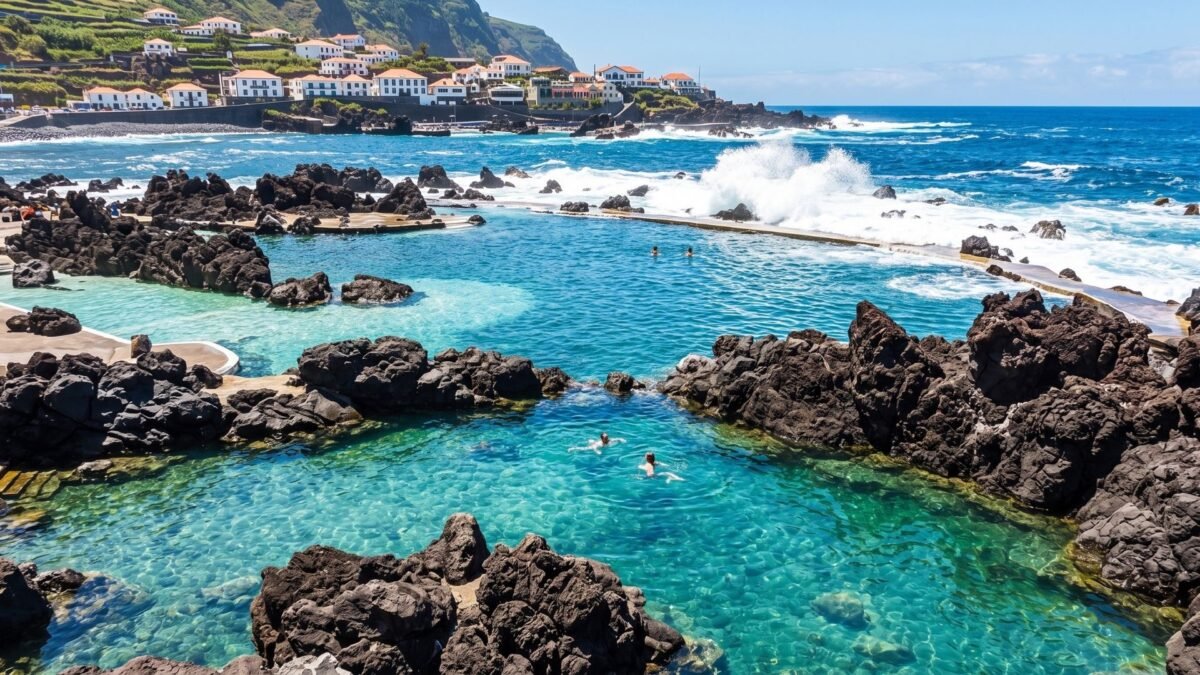
Have a waterproof phone pouch for this day. You’re going to want photos from inside the pools, and Atlantic waves have zero respect for electronics. A cheap dry bag has saved more phones than every rice trick combined.
After lunch, drive inland and up to Fanal Forest. This is the one that’ll make you gasp.
Fanal is part of the Laurisilva, the ancient laurel forest that once covered much of southern Europe before the ice ages wiped it out almost everywhere except here and a few other Atlantic islands.
It’s a UNESCO World Heritage site, and it looks like a fantasy film set. Massive old trees wrapped in moss, ground buried in ferns, and most afternoons, fog rolling through so thick the trees emerge from it like ghosts.
The trick with Fanal: you want the fog. Clear weather and it’s a nice forest. Foggy weather and it’s another planet. Check the webcams for the area before you drive up, and aim for mid to late afternoon when the mist usually rolls in.
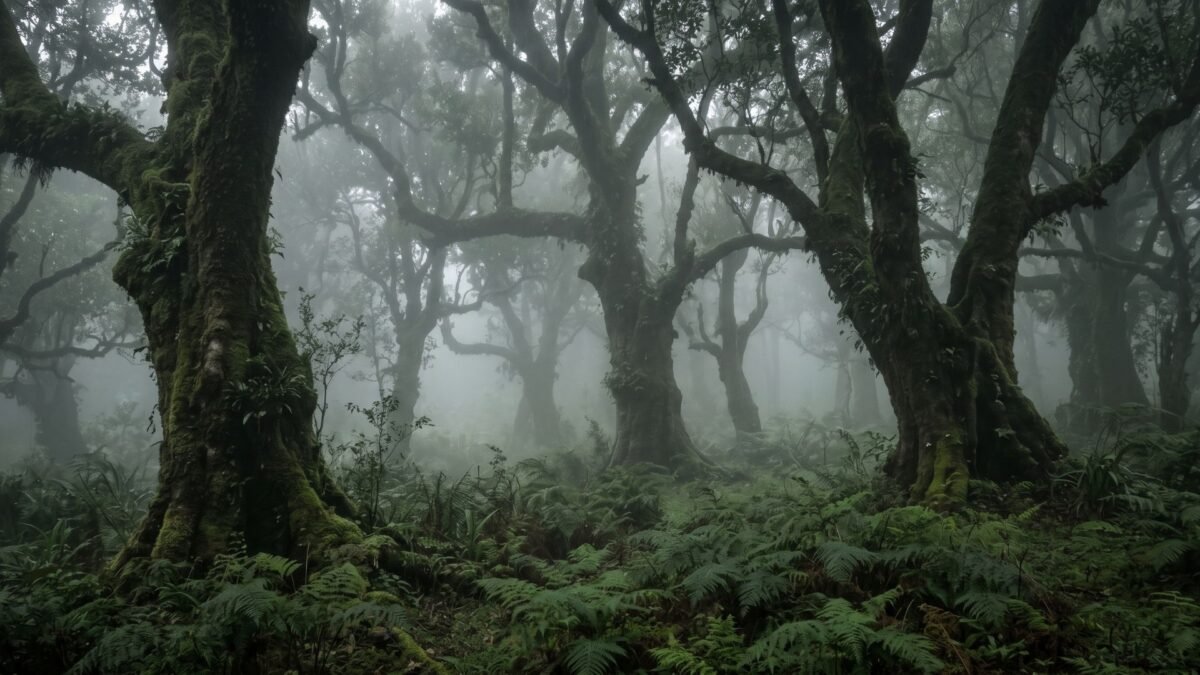
If you can, stay the night in São Vicente tonight. The north coast at night, with the mountains disappearing into dark clouds, feels like the edge of the world in the best way.
Day 6: Whales, the Skywalk, and the Best Poncha on the Island
Back to Funchal this morning for the tour I’d book first if I could only pick one.
Madeira is beside deep water close to shore, which means sightings aren’t really seasonal luck. Sperm whales are resident year-round, and bottlenose and common dolphin pods numbering in the hundreds follow the boats. I’ve done whale watches in Iceland and New Zealand.
Madeira was better, and cheaper. Reputable operators here follow a code of conduct on distance and approach, which is worth asking about when you book. Book the morning catamaran trip from the marina, roughly €35 to €45 per person depending on the operator. Calmer seas, softer light, and more animal activity.
Some catamarans have underwater viewing sections, so when the dolphins ride the bow wave, you watch them from inches away through the hull. Kids lose their minds. Adults lose their minds. Two things for this morning. Take seasickness tablets before you board, not after you feel queasy, because by then it’s too late. And wear polarized sunglasses.
They cut the glare off the water so completely that you can actually see the dolphins beneath the surface before they breach. Without them you’re watching shadows. With them you’re watching a nature documentary live.
My take on the tours: of all the options in Funchal marina, book the morning catamaran with the underwater viewing deck. It costs barely more than the basic boats and the difference in the dolphin experience is night and day.
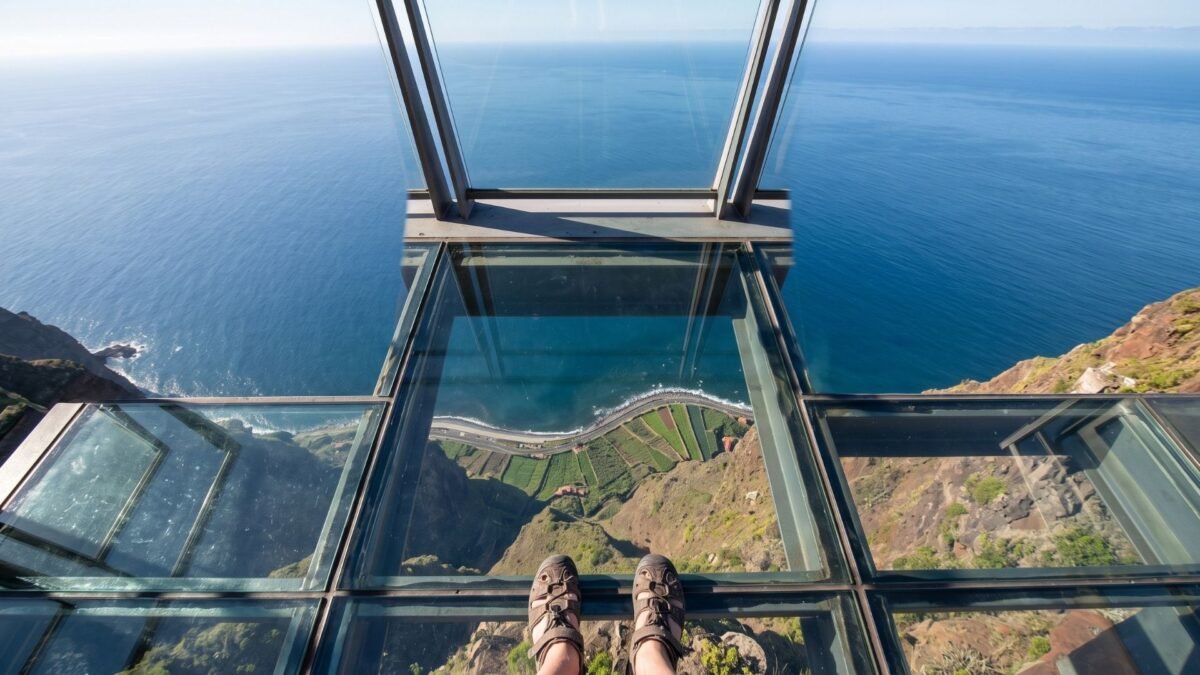
This afternoon, drive 15 minutes west of Funchal to Cabo Girão. At 580 meters, it’s one of the highest sea cliffs in Europe, and someone had the inspired or insane idea of bolting a glass-floored viewing platform to the edge of it.
You stand on glass. The ocean is directly below your feet. It feels wrong in the best way. Your brain knows there’s glass. Your body does not believe your brain.
Wrap up the day in Câmara de Lobos, the fishing village Winston Churchill painted. Colorful boats still bob in the harbor, fishermen still mend nets on the quay, and the poncha bars here are the best on the island. I’ll die on this hill. Taberna da Poncha is the famous one. Go, sit among the regulars, order a poncha de maracujá made with passion fruit, and toast a week well spent.
Day 7: Slow Morning, Souvenirs, and One Last Ridiculous Thing
Last day. Keep it light.
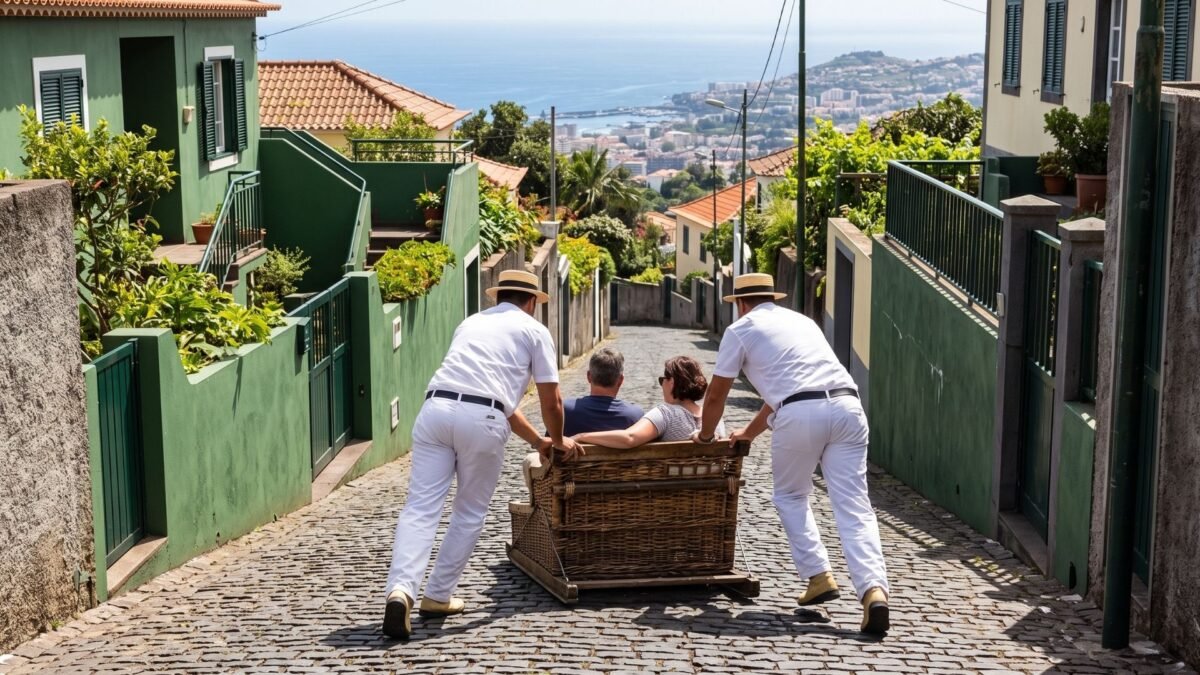
If your flight is late in the day, you’ve got time for one final Madeira experience, and it should be the toboggan. In the hillside suburb of Monte, above Funchal, traditional wicker sledges still run down the steep streets, steered by two men in straw boaters using their rubber boots as brakes. It’s been running since the 1850s.
It’s completely absurd. You will grin like an idiot the entire way down. It costs around €30 for two people, or slightly less solo, and you can pair it with the Monte Palace Tropical Garden above for one of the best views over Funchal bay.
For souvenirs, skip the airport shops. Get Madeira wine from Blandy’s Wine Lodge in Funchal, where you can taste before you buy. Pick up bolo de mel, the dark honey cake that keeps for months and tastes like Christmas.
And if you want something truly Madeiran, a bottle of aged aguardente, the cane spirit that goes into poncha, check your airline’s and your home country’s rules on carrying it before you buy.
Then drive to the airport along the coast, return the car, and start planning your return trip on the plane, because that’s what happens with Madeira. Everyone says they’re coming back. Most of them actually do.
What to Eat in Madeira (Don’t Sleep on the Food)
People come for the hikes and get surprised by the food. Madeira eats better than almost anywhere in Portugal at these prices, and a week here is enough time to work through the essentials.
Espetada. Beef rubbed in garlic and salt, skewered on a bay leaf branch, and hung from a hook beside your table. It arrives still sizzling. Every village has a place that does it over open coals, and the village versions beat the Funchal restaurants.
Bolo do caco. Garlicky flatbread cooked on a hot stone, served warm with butter that melts into every crevice. It comes with almost every meal and it’s dangerous.
Milho frito. Fried cubes of cornmeal, crunchy outside, soft inside, usually served alongside espetada. Better than fries. Not close.
The fruit at Mercado dos Lavradores. Madeira grows things you’ve never tasted. Custard apples. The anona. Bananas that taste like banana candy. Buy a bag for a few euros and eat it on a viewpoint. Agree the price before you accept a sample, because the upstairs sellers are persuasive.
Madeira wine. Not the stuff your grandmother cooked with. Real Madeira is a fortified wine that can age for decades, and a tasting flight at Blandy’s costs less than two cocktails anywhere else in Europe.
If you do one food thing all week, make it lunch at a village restaurant in the mountains after a hike. The menu will be short, everything will be local, and the bill for two with wine will rarely pass €40.
What to Pack for This Itinerary
Here’s the complete list, the stuff I actually carried and actually used:
The headlamp. I mentioned it three times and I’m mentioning it a fourth because it is the single most forgotten item for Madeira. Two of the island’s best hikes go through tunnels with no light. The Black Diamond Astro 300 is my pick: bright, light, cheap, reliable. If you buy one thing from this list, it’s this.
Hiking poles. Collapsible ones. Your knees will send a thank-you note after day three’s stairs. Carbon fiber versions weigh almost nothing and fit in a carry-on.
Waterproof hiking shoes. Not trail runners, not sneakers. Shoes. The volcanic rock chews up soft soles and the mud up north is a substance science hasn’t classified yet.
Microspikes. November through March only. See day three.
Layers. A packable down jacket and a lightweight rain shell. You’ll wear both, sometimes in the same hour.
Polarized sunglasses. For the ocean day and every driving day. The Atlantic glare is no joke.
Waterproof phone pouch and a small dry bag. For the lava pools and every boat trip.
Reef-safe SPF 50. UV climbs roughly ten percent for every thousand meters of altitude, so the sun at Pico do Arieiro is noticeably fiercer than at sea level, and it doesn’t be like it in the cold wind. Reapply at the summit, not after.
A European plug adapter and motion sickness tablets. The adapter for your electronics, the tablets for the mountain roads and the boat. Funchal’s streets are vertical and the coastal roads are curvy.
The Tours Worth Booking
Of everything bookable on the island, these five earned their place. Prices are per person, roughly, because operators shift with the season.
The whale watching catamaran, €35 to €45. Already covered. Book it first, book it early, book the morning slot, and get the one with the underwater viewing deck.
The guided Pico Ruivo trek, €40 to €55. For anyone unsure about the full unguided crossing, or anyone without a car who still wants the sunrise. They handle the logistics, you handle the walking.
The guided 25 Fontes walk, €35 to €45. Hotel pickup, no getting lost, local knowledge at the lagoon, and no worrying about the Rabaçal shuttle.
The Funchal food and wine tour, around €50. Poncha, espada, market tastings, and places you’d never find alone. Worth it for one capital night.
The Monte toboggan and gardens combo, around €30. The most fun fifteen minutes on the island plus one of its best gardens.
Quick Answers to the Questions Everyone Asks
Is 7 days enough for Madeira? Yes. This itinerary covers the whole island without rushing. You could happily spend two weeks, but a week is the complete experience.
Do I need a rental car? Strongly recommended, yes. The alternative is basing in Funchal and taking tours everywhere, which works but kills the spontaneous stops that make Madeira special. Budget €25 to €40 a day depending on season.
Is Madeira expensive? Madeira is mid-range for Europe. Budget travelers manage on about €80 a day, comfortable travelers on €150. Food and tours are cheap by Western European standards. The rental car is your biggest cost.
Is Madeira safe? Very well. It’s consistently ranked among the safer destinations in Europe, for solo travelers and families alike. The real hazards here are the roads and the trails, not crime.
Madeira or the Azores? Different trips. Madeira is the hiker’s island with better food, better weather, and easier logistics. The Azores are wilder, quieter, and more spread out. If you only have a week, Madeira.
Can you actually swim in Madeira? Yes. The lava pools at Porto Moniz and Seixal are the best swimming spots, and Calheta has a sandy beach with imported golden sand, which is a wonderfully Madeiran solution to a volcanic problem.
What should I book before flying? The whale watching trip, any guided hikes you want, your rental car, and your trail tickets where a fee applies. Everything else you can decide on the island.
Pin This for Later
Seven days, one island, and enough memories to last until you inevitably come back.
If this itinerary helped you plan, grab the free printable version. It’s this whole article as a day-by-day PDF with the trail distances, times, and packing list formatted for your phone. The link is in the box below. It takes ten seconds and it’s the version you’ll actually use at 6 AM on a mountain.
And if you’ve got an extra day or two, my guide to Madeira’s hidden gems covers everything this itinerary had to leave out. The abandoned trails, the pools the tour buses pass, the village where lunch costs less than your coffee at home.