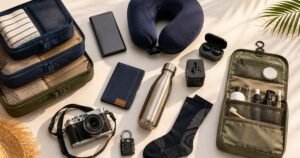
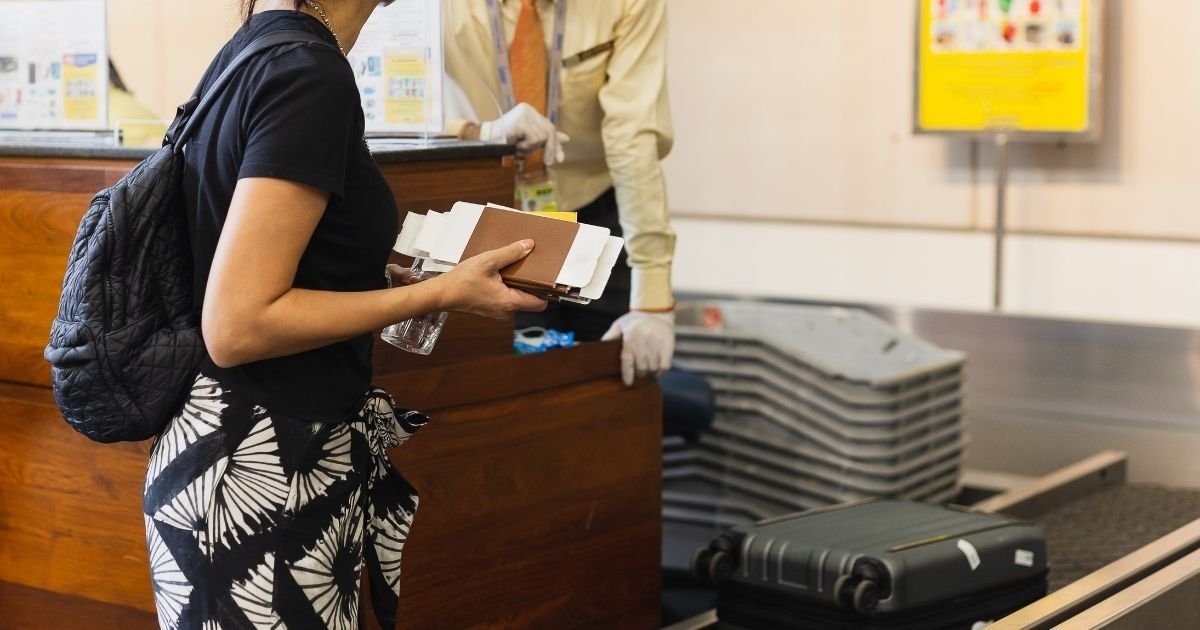
Most packing guides hand you a list and call it a checklist. Not as this combination “packing-checklist..”
Those are two different things, and the difference matters more than most people realize until they are standing at airport security pulling a full-size conditioner out of their bag while the line behind them goes quiet in that particular way queues do.
A list is a collection of items. A checklist is a system that tells you what to do, when to do it, and in what order.
It covers the things you need to pack, the things you need to confirm before you leave, the things you need to do the day before your flight, and the things you need to check one final time at the door.
This is the second kind.
It is built for the person who has never traveled before, or who has traveled once or twice and knows they missed something but cannot figure out what. It is also built for the person who is experienced enough to know that the things that go wrong on trips are almost never the big things.
They are the small things. The wrong voltage adapter. The card that was not set up for international use. The hotel address that was in the email you forgot to screenshot before you lost WiFi.
Go through this checklist five days before your trip. Then again the day before. Then one final time at the door.
That rhythm is the whole system.
Why a Packing Checklist Works Differently to a Packing List
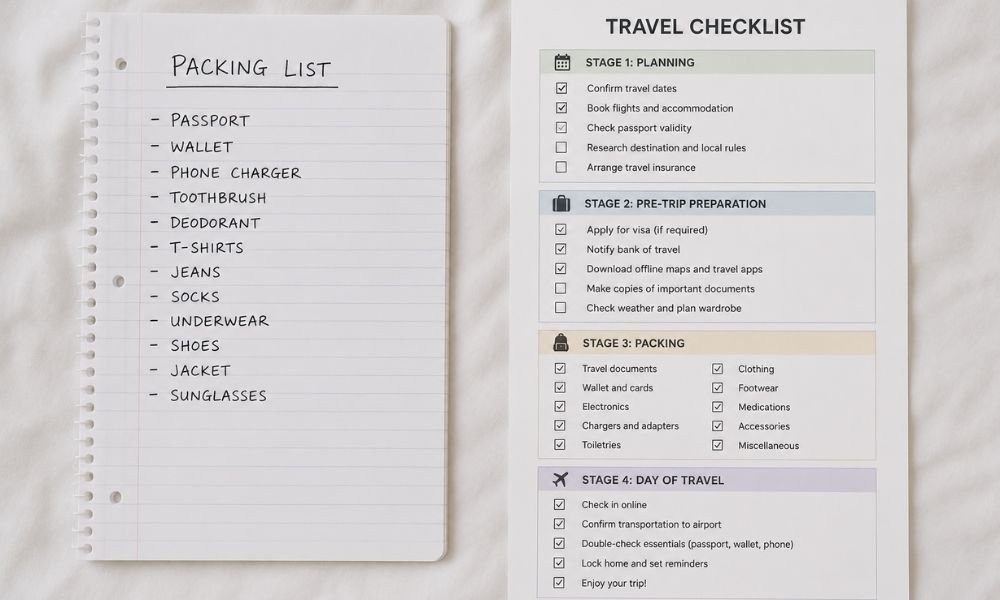
A packing list answers one question: What do I need to bring? A good packing checklist answers three simple questions: What do I need to bring? What do I need to do before I leave? And what do I need to make sure is already sorted?
The second and third questions are where most first-time travelers fall down. Not because they forget to pack their toothbrush.
Because they forgot to tell their bank they were traveling. Because they assumed their travel insurance covered activities it does not. Because the offline map they planned to rely on never finished downloading.
Those are not packing failures. They are planning failures, and a proper checklist catches them before they become a problem you are solving in an unfamiliar city.
This checklist is split into five stages. Work through them in order.
Stage One: Five Days Before You Leave
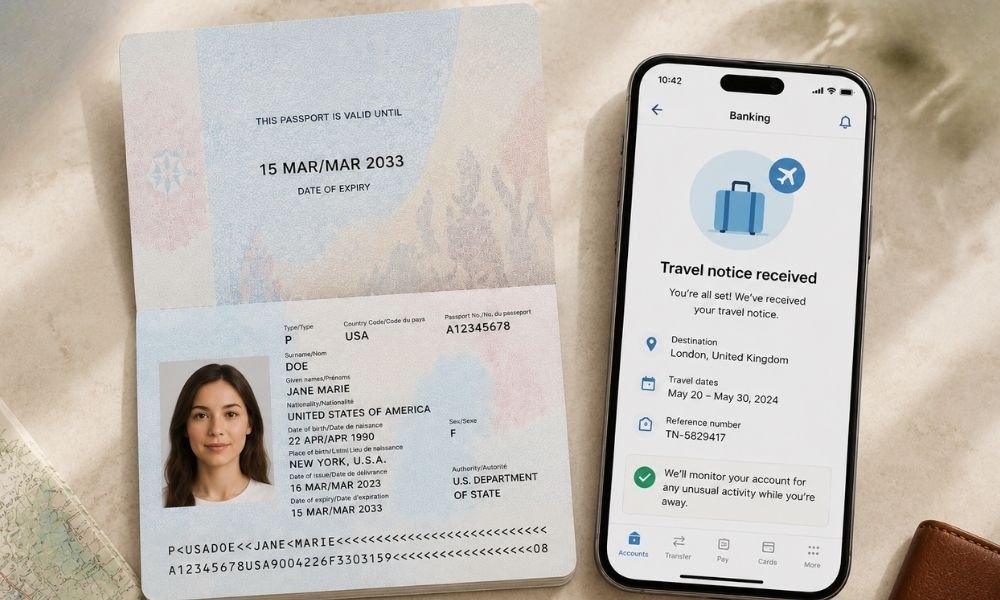
This is the most important stage and the one most people skip. Five days out, you still have time to fix problems. The night before departure, you do not.
Documents and admin:
- Check your passport expiry date. Many countries require at least six months of validity beyond your return date, not just your departure date. If your passport expires in less than six months, renew it before you book anything else.
- Check whether your destination requires a visa. If it does, confirm you have applied with enough lead time. Some visa approvals take days, some take weeks.
- Print a physical copy of your travel insurance policy, your accommodation booking confirmation for the first night, and any transport tickets that require proof of booking at the border.
- Email yourself scans of your passport photo page, your travel insurance documents, and any visas. If your bag is stolen, you can access these from any device anywhere in the world.
- Call your bank or log into your banking app and notify them of your travel dates and destination. A card that gets blocked abroad because your bank flagged it as suspicious activity is a specific kind of inconvenience you can avoid in under three minutes.
- Check the balance on any travel cards and top up if needed.
- Confirm your accommodation has your correct arrival time, especially if you are arriving late or early outside standard check-in hours.
Health and medications:
- Count your prescription medications and confirm you have enough for the full trip plus three to five extra days in case of delays, missed connections, or an extended stay.
- Check whether your medications require a doctor’s letter to cross certain borders. Some countries are strict about what you can carry without documentation.
- Book any required vaccinations or travel health appointments if you have not already. Some vaccines need two doses weeks apart.
- Check the tap water situation at your destination. If it is not safe to drink, plan for a filtered water bottle or budget for bottled water.
Tech:
- Check the outlet type for your destination and confirm your travel adapter covers it. Not all universal adapters cover all socket types.
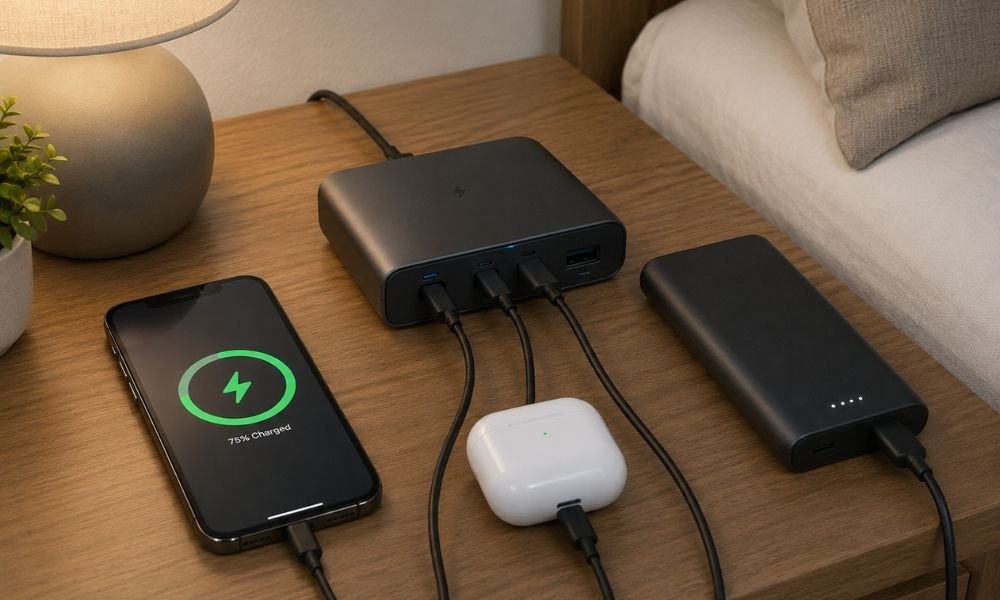
- Charge your power bank fully and test it.
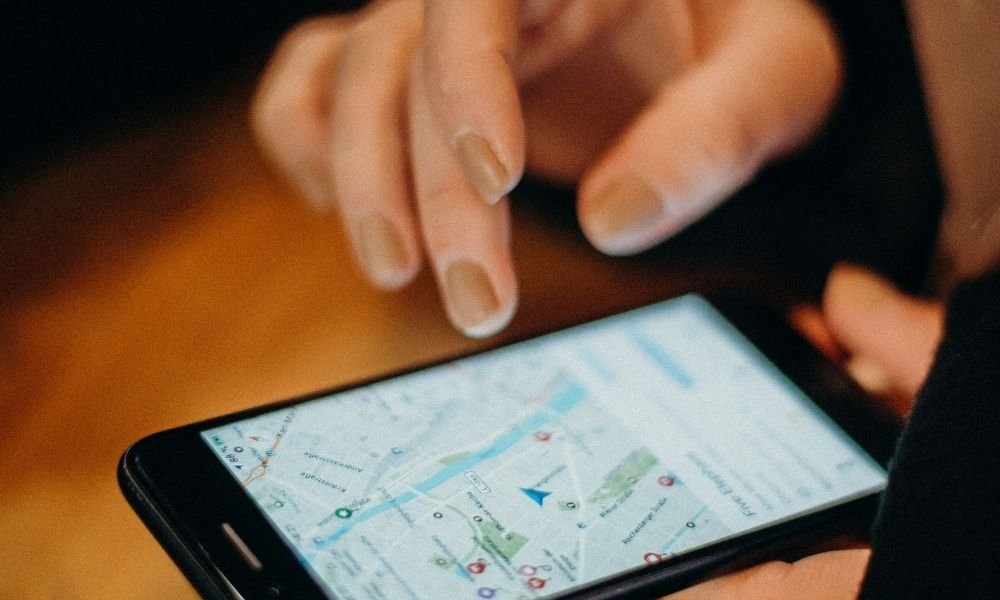
- Download offline maps for your destination before you leave home. Do this on WiFi because the files are large. In Google Maps, search your destination, open the menu and find the offline maps option.
- Download an offline translation app if you are traveling somewhere where you do not speak the language. Again, do this before you lose WiFi.
- Back up your phone photos to cloud storage so you are not traveling with months of irreplaceable photos on a device that could be lost or stolen.
Bag and gear:
- Pull out the bag you are planning to travel with and check it properly. Look at the zips, the straps, and the main compartment. A bag that breaks mid-trip in a country where your exact replacement is not available is an expensive problem.
- Lay out everything you plan to pack before anything goes in the bag. This gives you a visual on whether you are overpacking before it is too late to do anything about it.
- Weigh your bag if you are flying. Check your airline’s carry-on weight limit, not just the size. Budget airlines in particular are strict, and the gate fee for an overweight carry-on costs more than most of the things inside it.
Stage Two: The Packing Checklist Itself
Work through each category in order. Tick as you go. If you do not have an item and need one, add it to a shopping list now while you still have time.
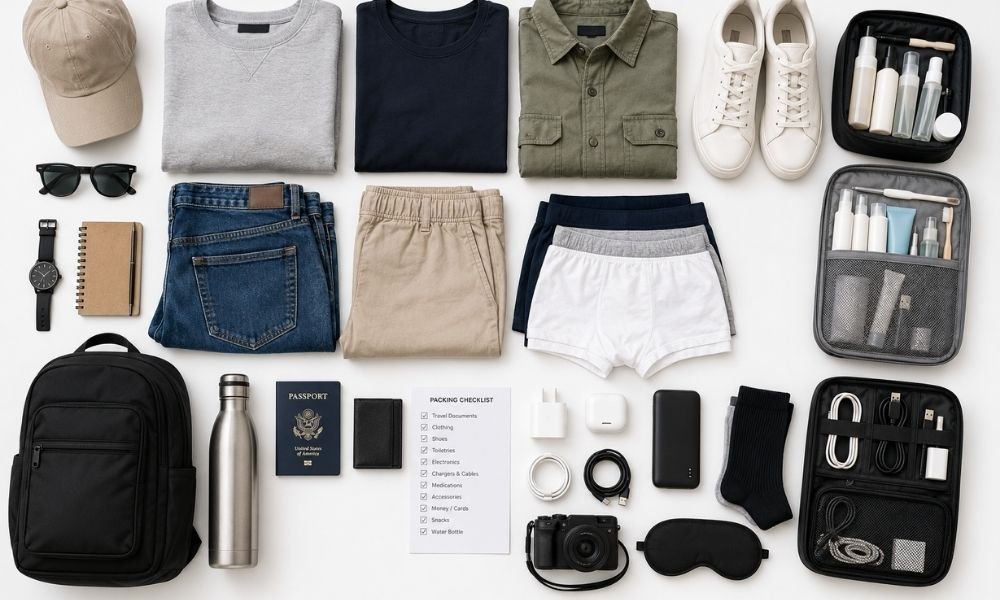
Documents (go in carry-on, never checked luggage):
- Passport
- Printed travel insurance documents
- Printed accommodation confirmation for first night
- Any required visas, printed or downloaded offline
- Printed emergency contact list including your accommodation address and the nearest embassy contact for your home country
- Travel card and at least one backup payment card from a different account
- Small amount of local cash for arrival
Clothing:
- Seven pairs of underwear in quick-dry or merino wool fabric
- Six pairs of socks including at least one compression pair for the flight
- Three to four tops that work across multiple outfits
- Two pairs of bottoms
- One packable warm layer, either a fleece or a lightweight down jacket depending on your destination temperature
- One packable rain jacket
- One outfit that works for a smarter setting if your trip requires it
- Swimwear if applicable
- Sleepwear or a sleep layer if you run cold
Footwear:
- One broken-in pair of walking shoes. Not new shoes. Broken in. This matters.
- One lighter pair for evenings, beach days, or situations where your main shoes are too heavy
Tech:
- Universal travel adapter
- Power bank, charged
- Phone charging cable
- Laptop or tablet and its charger if you need it for the trip
- Noise canceling headphones or earbuds
- Camera and memory card if you are bringing one
- Waterproof phone pouch if your destination involves water
Health and hygiene:
- Prescription medications, labeled and in original packaging where possible
- Small first aid kit with plasters, blister pads, antiseptic wipes, and pain relief
- Electrolyte sachets
- Sunscreen appropriate for your destination
- Insect repellent if applicable
- Quick dry travel towel
- Shampoo bar or travel-size shampoo in a 100ml or smaller container
- Toothbrush and toothpaste
- Deodorant, travel size
- Any personal hygiene items specific to your needs
Safety and security:
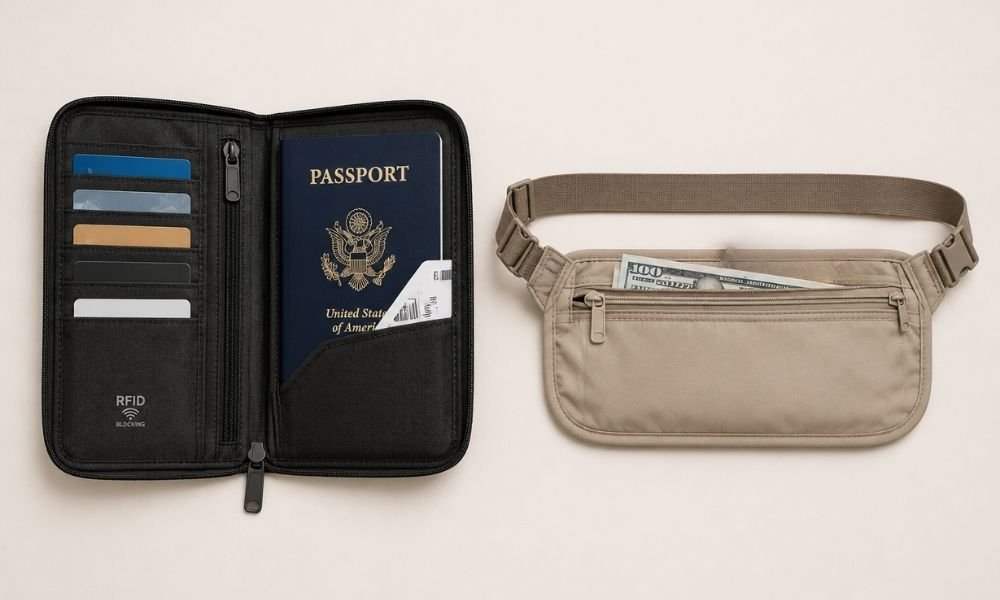
- RFID-blocking travel wallet or passport holder with RFID blocking
- Slim under-clothes money belt
- TSA-approved combination locks for your bag
- Portable door lock
- Personal safety alarm if traveling solo
Comfort and sleep:
- Sleep mask
- Earplugs or noise-canceling earbuds
- Travel pillow if you are doing long-haul flights or overnight transport
Bag organisation:
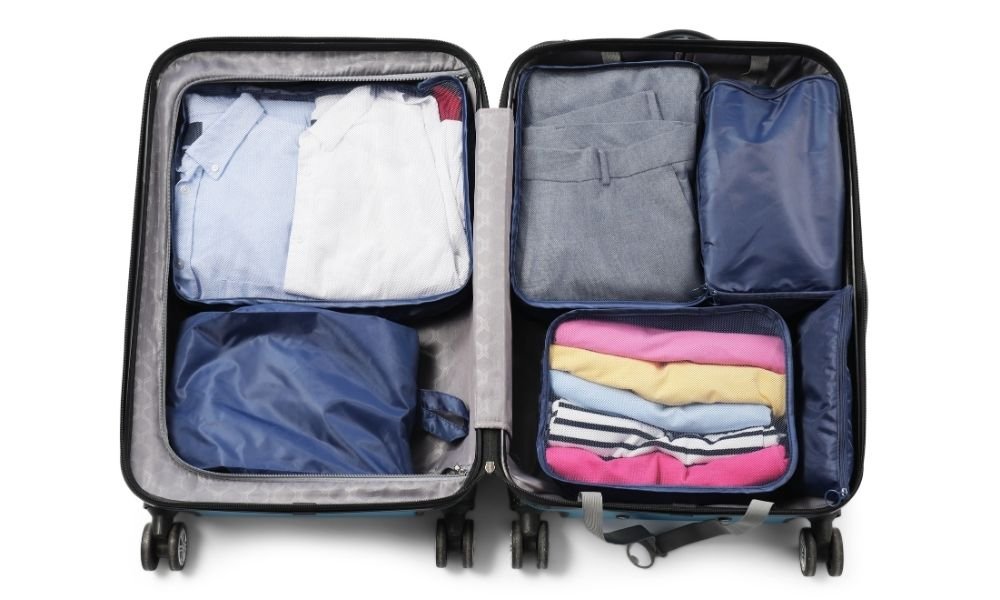
- Compression packing cubes for clothing
- Clear resealable toiletry bag for liquids (100ml containers only)
- Waterproof dry bag for electronics and documents
- Cable and accessories organiser pouch
Stage Three: The Day Before Your Flight
At this point, the bag should already be packed. Stage three is not about adding items. It is about confirming everything that could go wrong has been addressed.
Confirm and check:
- Recheck your flight time and the correct departure terminal. Terminals change. Check the airline’s website or app directly, not just your original booking confirmation.
- Confirm how you are getting to the airport and how long it actually takes. Add thirty minutes to whatever you think is a reasonable buffer. Then add another thirty.
- Charge every device overnight. Phone, laptop, camera, power bank, earbuds. Everything.
- Weigh your bag one final time if you are flying carry-on only.
- Screenshot or save offline your boarding pass. Do not assume you will have signal at the airport.
- Set two alarms for the morning. Different times, different alarm sounds if you are someone who dismisses the first one without waking up.
- Make sure your accommodation has your flight details if they are arranging any kind of airport transfer or early check-in.
- If you are traveling with medication that requires refrigeration, confirm your accommodation has a fridge before you arrive rather than after.
Practical home tasks:
- Empty the fridge of anything that will go off while you are away.
- Set timers on any lights or ask someone to check your place if you are away for longer than a few days.
- Make sure windows are closed and the front door is properly locked. This sounds obvious. It is on the checklist because obvious things are the ones people skip.
- Leave a copy of your itinerary with someone at home, whether that is a family member, a friend, or a neighbor you trust. Someone who is not traveling with you should know where you are going and how to reach you.
Stage Four: The Morning of Your Flight
Keep this section short and direct. The morning of a flight is not the time for decision-making.
The non negotiable three:
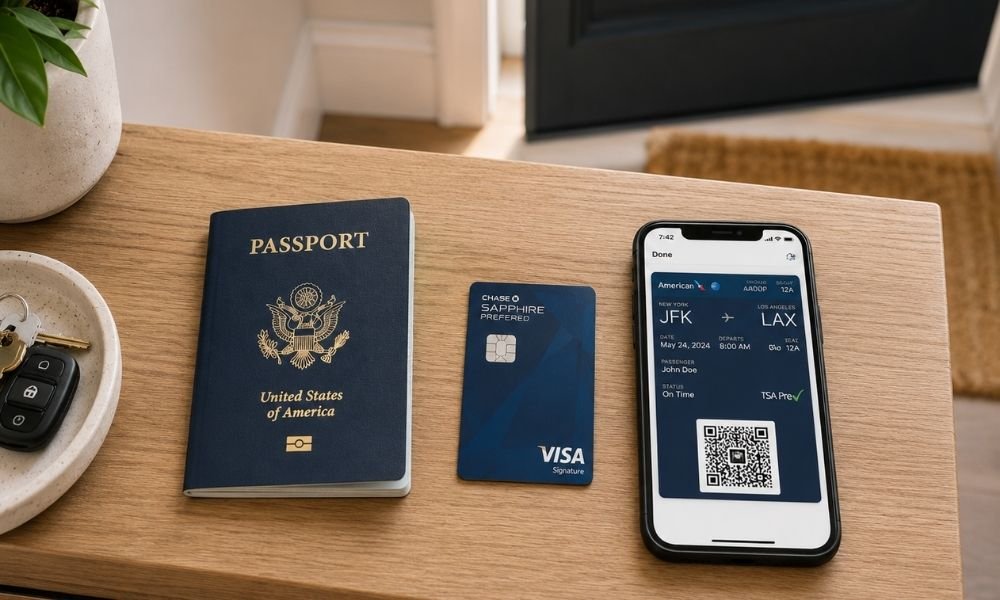
Before you close the front door, physically touch these three things. Passport. Cards. Phone with boarding pass downloaded offline.
If you can physically touch all three, you can leave. Everything else on your packing checklist can be replaced, bought, or worked around at your destination. Those three cannot.
The quick sweep:
- Walk through every room you used this morning. Bathroom, bedroom, kitchen. Check for your phone charger specifically. It is the most commonly left-behind item in hotel rooms, and the pattern starts at home.
- Check that your power bank is in your carry-on, not in your checked bag if you have one. Power banks must travel in the cabin, not in the hold.
- Lock up and leave.
Stage Five: At the Airport
This stage is not about your bag. Your bag is packed and it is too late to add anything. This stage is about not losing time to avoidable problems.
Before security:
- Have your boarding pass ready before you join the security queue, not while you are at the front of it.
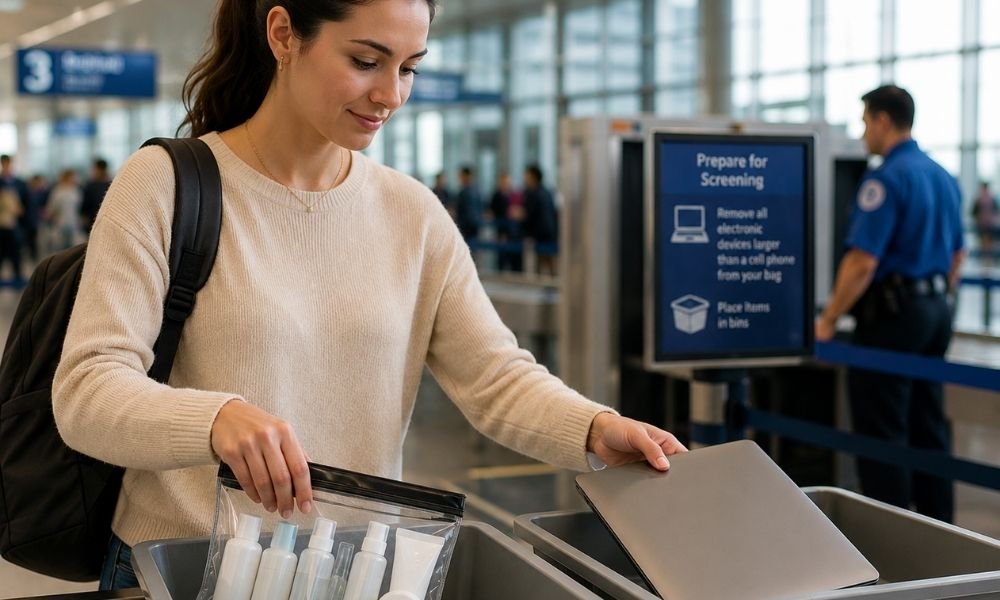
- Remove your laptop from your bag and place it in a separate tray if required by your airport’s security process.
- Move your liquids bag to an easily accessible outer pocket so you can pull it out quickly.
- Check that no liquids over 100ml accidentally made it into your carry-on. A full-size deodorant or a large moisturiser will be confiscated, and you will have paid for it.
After security:
- Check the departures board for your gate. Gates change regularly, especially on busy travel days.
- Find your gate before you find coffee. Know exactly where you are going before you commit to a queue.
- Top up your water bottle at a fountain or buy a large bottle now. Flight cabin air is very dry and most people underestimate how dehydrated they get on long flights.
The Travel Check List for Long-Haul Flights Specifically
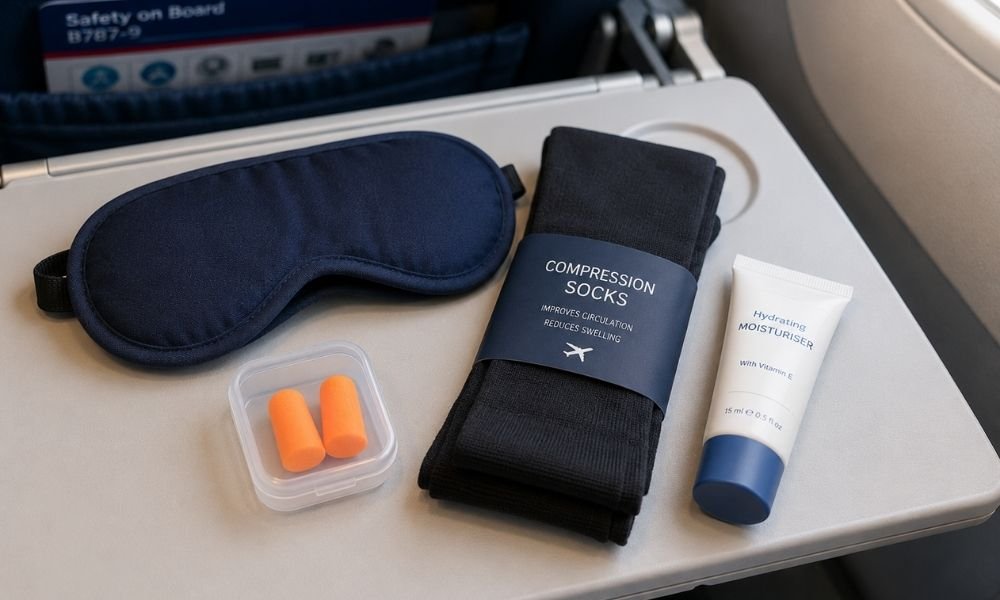
Long-haul flights have their own checklist inside the main checklist. If your flight is over six hours, these items belong in your personal item or day bag, not buried in your main carry-on.
- Sleep mask
- Earplugs or wireless noise canceling headphone
- Compression socks (put these on before boarding, not mid-flight)
- A change of clothes or at minimum a fresh t-shirt if it is an overnight flight
- Toothbrush and toothpaste for the morning
- Moisturiser and lip balm
- An empty water bottle to refill after security
- Phone and power bank for entertainment, not buried under everything else
- Snacks you actually like, because airline food is unpredictable and the good options sell out first
Frequently Asked Questions
What is the difference between a packing list and a packing checklist?
A packing list tells you what to bring. A packing checklist tells you what to bring, what to do before you leave, and what to confirm is handled. The checklist format catches the planning failures that a packing list misses entirely, things like notifying your bank, downloading offline maps, or confirming your accommodation has your arrival time.
When should I go through my travel checklist?
Go through it in three passes. First pass five days before departure, which gives you time to buy anything missing and sort any admin. Second pass the evening before, which covers confirmations and last-minute checks.
Third pass at the door on the morning of your flight, which is just the non-negotiable three: passport, cards, boarding pass.
What goes in carry-on versus checked luggage?
Your carry-on should contain everything you cannot afford to lose or delay: passport and documents, travel insurance paperwork, all medications, your power bank (power banks are not permitted in checked luggage by most airlines), electronics, valuables, and one change of clothes in case your checked bag is delayed.
Your checked bag carries the bulk of your clothing and anything that does not meet carry-on size or liquid restrictions.
What should a trip checklist include beyond just packing?
A complete trip checklist covers six areas: documents and admin, health and medications, tech and connectivity, packing the physical bag, home tasks before you leave, and confirmation checks the day before your flight. Most people only think about the packing. The admin and confirmation stages are where the expensive and stressful mistakes actually happen.
What is the most common thing people forget to pack?
Based on what travelers consistently report: phone charger, travel adapter, and any medications they take so regularly they do not think of them as something to pack. All three are on this checklist. All three are in sections that are easy to skim past. Read those sections slowly.
Do I need travel insurance before I tick off this checklist?
Yes, and this is worth saying clearly. Travel insurance is not optional. Standard health insurance from your home country does not cover medical treatment abroad in most cases, and a medical evacuation from a remote destination without it can cost more than most people earn in a year.
Sort this before you start packing anything else. If you do not have a policy, SafetyWing offers flexible travel medical cover starting from a few dollars a day that you can purchase even after you have already left home.
As an Amazon Associate, Wandervoyant earns a small commission from qualifying purchases made through links on this page. This comes at no additional cost to you and helps keep this site running. We only recommend products we genuinely believe are worth your money.
Related reading: