
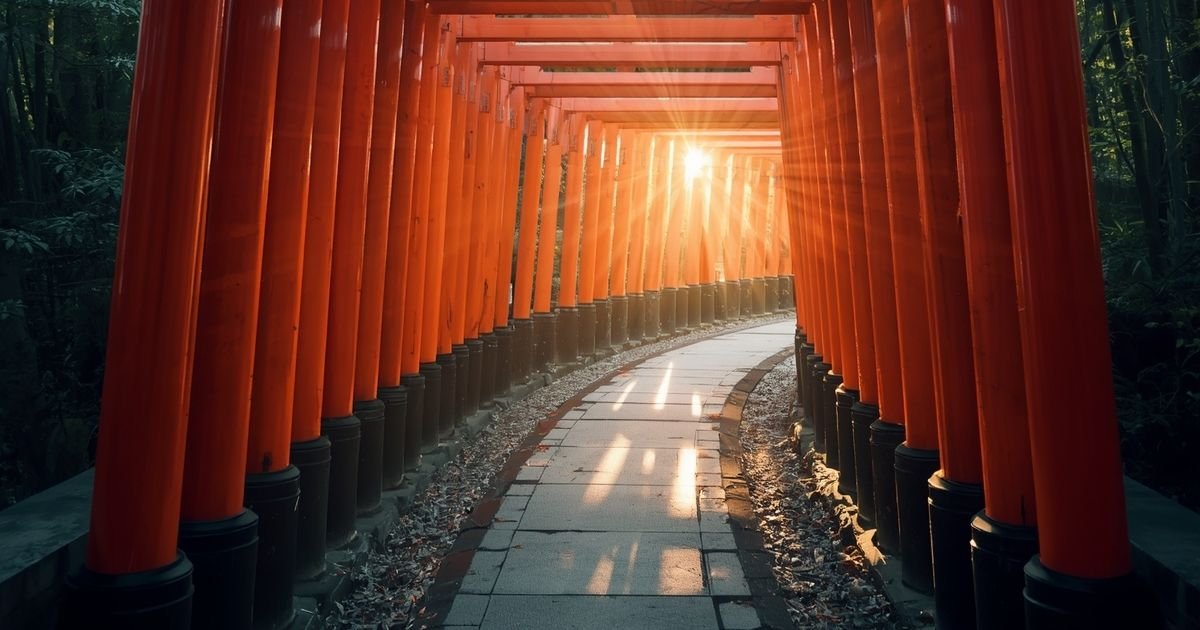
Fushimi Inari skip the line tickets do not exist, and the shrine does not sell entry tickets of any kind. There is no gate, no fee, and no queue to buy your way past. The real problem visitors face is foot traffic density on the torii gate paths, which peaks between 9am and 3pm and makes the lower trail feel like a bottleneck. A well-timed visit or a guided early-morning tour solves this far more effectively than any ticket product ever could.
If you landed here searching for advance entry passes or crowd-bypass options, the confusion is completely fair. Other major sites in the Kyoto and Kansai region do require tickets and can have genuine queues. Kinkaku-ji, Nijo Castle, and the bamboo grove at Arashiyama all attract long waits during peak season. Assuming Fushimi Inari works the same way is a logical leap to make.
It does not. And once you understand what the actual crowd problem looks like here and why it forms, the solution becomes obvious. This guide covers all of it: what the shrine actually is, why it is free, where the crowds concentrate and when, and how to have a version of this morning that feels nothing like the one in the overcrowded photos.
Is Fushimi Inari Free to Enter?
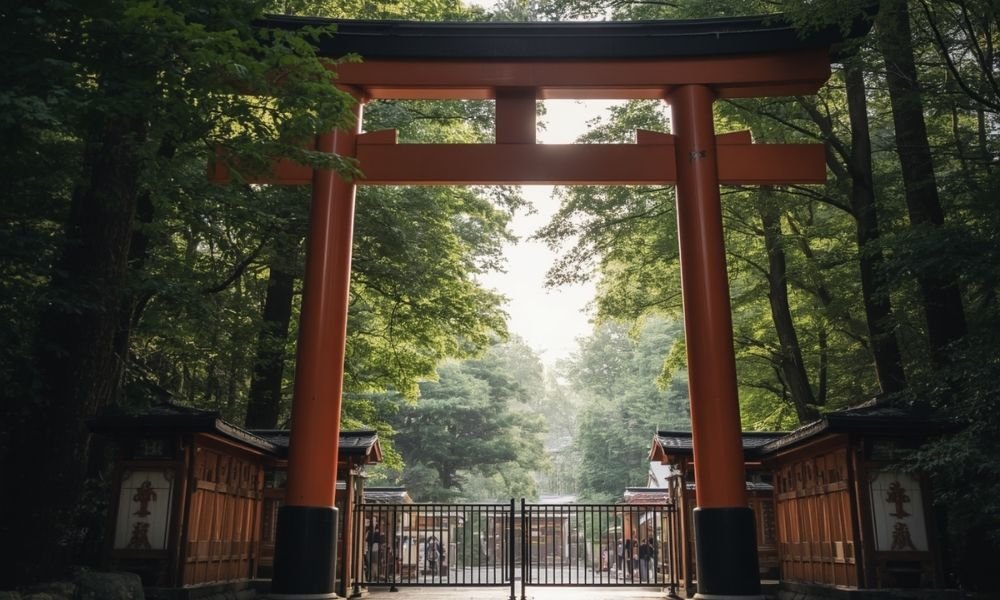
Yes, completely free. Fushimi Inari Taisha is one of Japan’s most important Shinto shrines, and like the vast majority of Shinto shrines across the country, it charges no admission. There are no entry gates, no ticket booths, and no points along the mountain trail where you need to pay or show anything to continue.
This applies to the full route. From the main Romon Gate at the base, through the famous Senbon Torii gate tunnels, up past the Yotsutsuji intersection at the halfway point, and all the way to the shrine’s summit at 233 meters above sea level. Every part of it is open access.
The shrine is also open around the clock, every day of the year. The outdoor paths and torii gate tunnels have no closing time. The inner shrine buildings and formal halls have their own hours for ceremonies and worship, but nothing prevents you from walking the mountain at 5am, at midnight, or any hour in between.
The reason for this is structural rather than generous. Fushimi Inari Taisha is a functioning religious site, not a tourist attraction managed for revenue. It was founded in 711 AD, making it one of the oldest shrines in Japan, and it operates under the same tradition of open access that governs most Shinto worship in the country.
According to Japan’s official tourism authority, the shrine serves as the head shrine for approximately 30,000 Inari shrines spread across Japan, which gives some sense of its religious weight beyond the tourism context. You can read more about that history directly at the Japan National Tourism Organization’s Fushimi Inari page.
What Is the Shrine Actually About?
This is the part most crowd-avoidance guides skip entirely, and it is also the part that makes the place feel like something more than a photo location once you know it.
Fushimi Inari is dedicated to Inari Okami, the Shinto deity of rice, agriculture, foxes, fertility, and worldly success. The association with business prosperity is why the trail is lined with thousands of torii gates rather than hundreds.
Each gate is donated by an individual or a company as an act of gratitude or petition, with the donor’s name and the date of donation inscribed on the back of every gate. Walk the trail facing uphill and you see the bright vermilion. Turn around and you see the ledger of everyone who asked for something and then paid to say thank you.
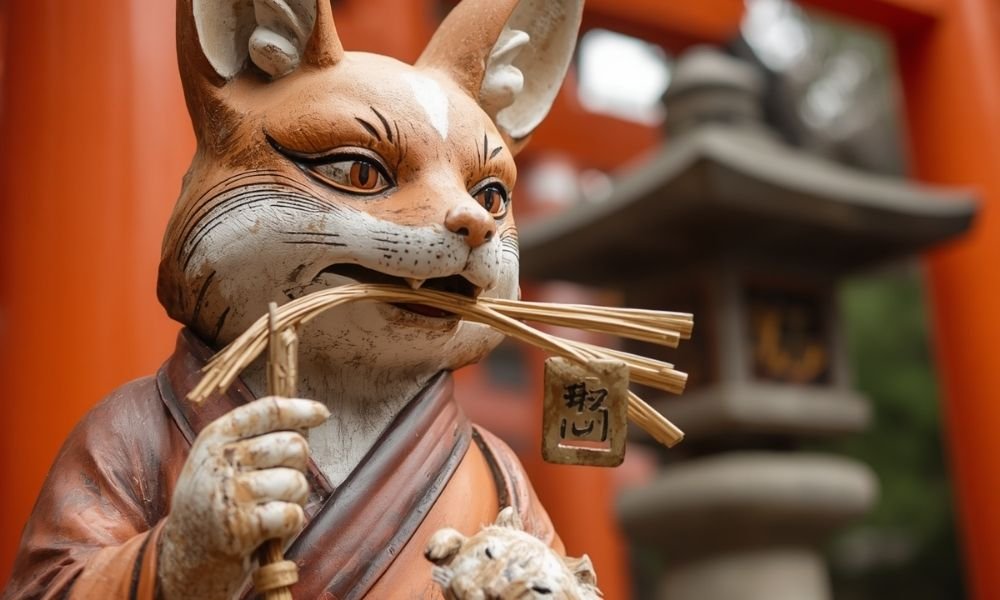
The fox statues you see throughout the shrine, often holding a key, a sheaf of rice, a jewel, or a scroll in their mouths, are messengers of Inari rather than the deity itself.
The key held by many of the foxes is said to unlock the rice granary, which in an agricultural society was the most literal form of prosperity imaginable. The color of the gates is a specific shade of vermilion that in Shinto tradition is understood to ward off evil and represent the boundary between the human world and the divine.
Knowing this before you walk changes the experience in a way that’s hard to articulate until you’ve had it. The gates stop being a backdrop and start being a record of human hope.
So What’s Actually the “Line” People Are Trying to Skip?
There is no line in the ticket-queue sense. What there is, for several hours in the middle of most days, is a dense, slow-moving crowd funneled through narrow stone paths and gate tunnels wide enough for two people walking side by side.
The congestion is almost entirely concentrated in the first section of the trail, from the Romon Gate up through the initial Senbon Torii tunnels to the first set of small sub-shrines. This stretch runs maybe 10 to 15 minutes of walking under normal conditions. During peak hours it can stretch to 30 or 40 minutes of shuffling behind tour groups while holding a phone over someone else’s head.
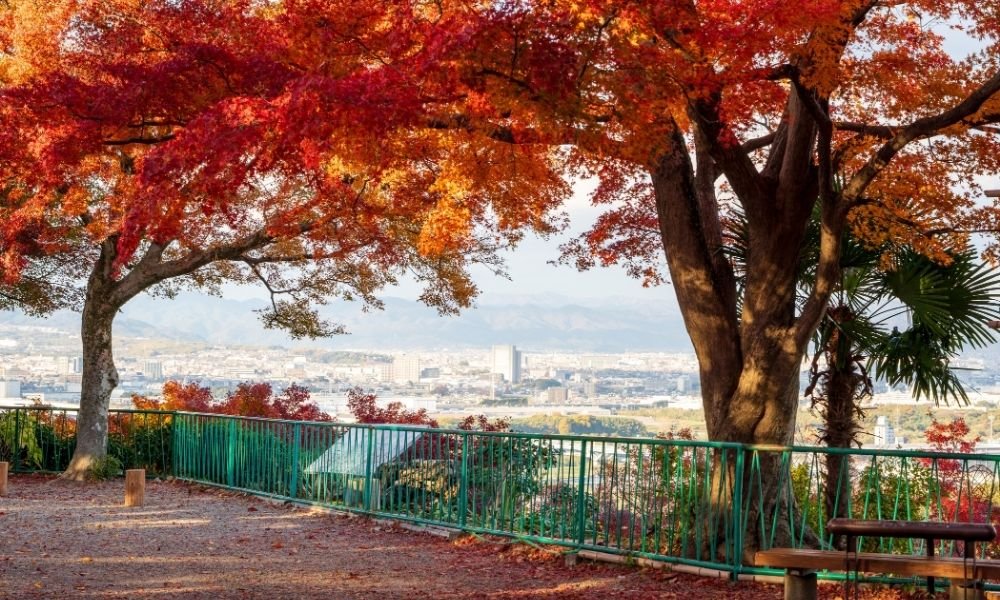
Past this section, the trail opens up and the crowd thins considerably. Most day visitors and tour groups stop somewhere in the first major photo spot, take their pictures, and turn back. The Yotsutsuji intersection, roughly halfway up at the point where the trail forks and a bench offers the first clear city view, is where the crowd drops from dense to scattered. Above that, you can walk long stretches of the upper mountain with very few other people around.
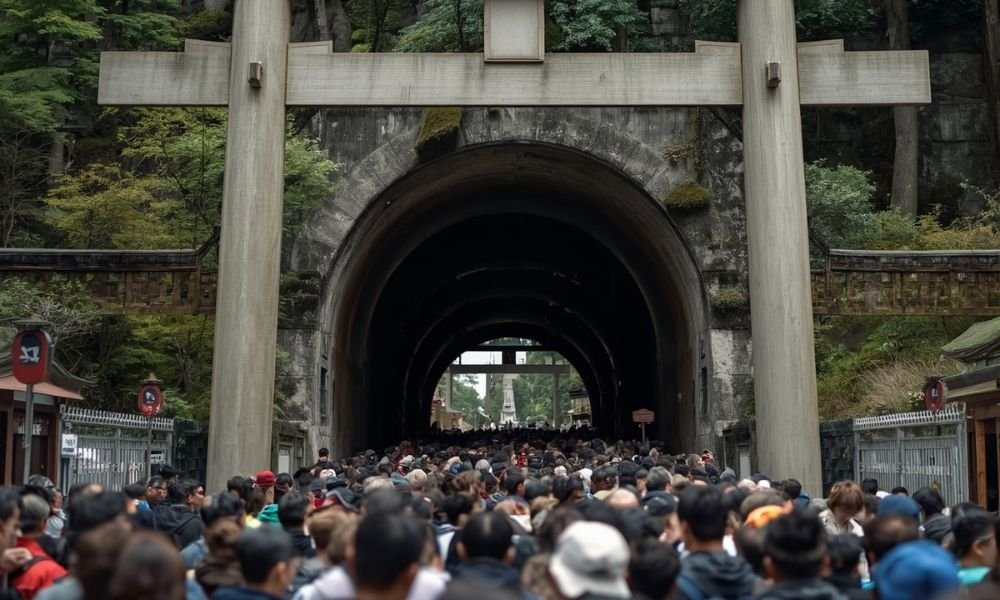
So the “line” people are trying to skip is really a 15-minute bottleneck that forms at a predictable time of day in a predictable location on the trail. It is not a gate, not a queue, and not something any ticket product addresses.
Crowd Density at Fushimi Inari: Hour by Hour
This breakdown does not appear in most travel guides, and it is more useful than general advice to “arrive early.” These estimates are based on documented visitor flow patterns at the shrine across peak and off-peak periods.
| Time of Arrival | Lower Trail (Base to First Tunnel) | Mid-Trail (Yotsutsuji and Above) | Notes |
|---|---|---|---|
| 5:00am to 6:30am | ✓ Near empty | ✓ Empty | Best light in summer, near solitude on the path |
| 6:30am to 8:00am | ✓ Light traffic, some photographers | ✓ Very quiet | Ideal window for unhurried visits |
| 8:00am to 9:00am | ~ Filling up, still manageable | ✓ Light traffic | Last comfortable window before tour buses |
| 9:00am to 11:00am | ✗ Busy, first tour groups arriving | ~ Moderate | Lower tunnel photo spots become difficult |
| 11:00am to 3:00pm | ✗ Peak density | ✗ Busy near Yotsutsuji | Most crowded period of the day |
| 3:00pm to 5:00pm | ~ Thinning out slowly | ~ Moderate | Afternoon light can be pleasant in autumn |
| 5:00pm onward | ✓ Noticeably quieter | ✓ Quiet | Evening visits underrated, especially in summer |
Peak season, which runs from late March through early May and again throughout November, adds roughly one density level to every row in this table. A 9am visit in late April during cherry blossom season sits closer to the 11am crowd density of a normal weekday. If your trip falls in peak season and you cannot manage a sunrise arrival, an evening visit from 5pm onward is the next most effective option.
How to Avoid the Crowds Without Paying for Anything
Arrive Before 7am
The simplest and most reliable approach. The Keihan Line from central Kyoto runs early enough to put you at the shrine entrance by 5:30am if you want it. JR Nara Line from Kyoto Station also works, with Inari Station one stop away and a two-minute walk from the main gate.
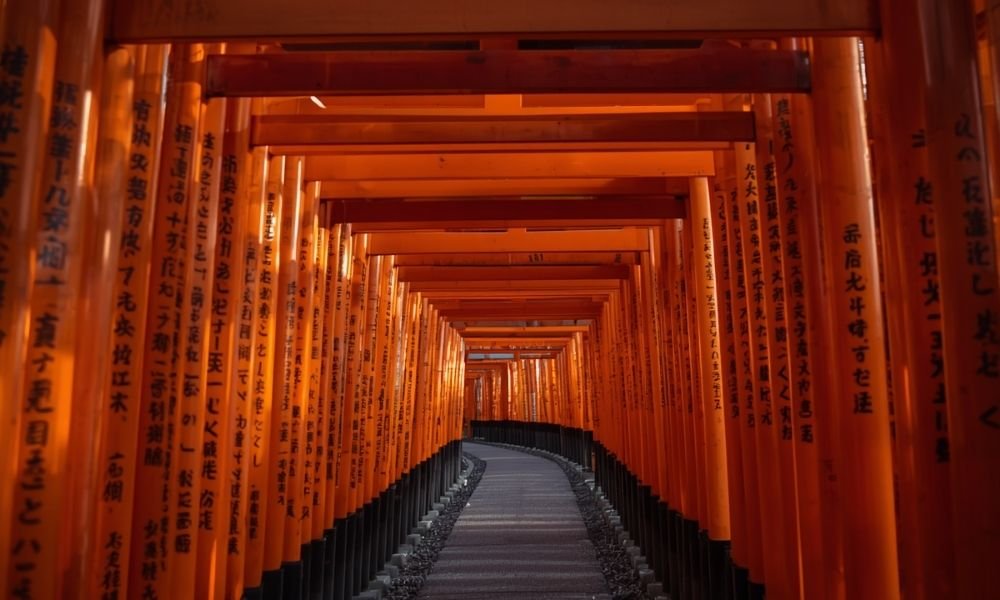
Getting there before 7am means you walk the lower gates in genuine quiet. In spring and summer the light at that hour is exactly what the vermilion color of the gates is made for. Long shadows, warm tone, and no one in your frame unless you want them there. In winter the light comes later but the air is sharp and the mountain trail feels more austere in a way that has its own reward.
Walk Past the First Photo Spot
This is probably the most underused piece of advice for Fushimi Inari. The first major gate tunnel is also the most photographed and the most congested. Most visitors stop here, spend 10 to 20 minutes getting their shots, and leave. If you keep walking, the geometry of the crowd changes almost immediately.
By the time you reach the Yotsutsuji intersection, the mid-mountain viewpoint with the bench overlooking Kyoto, you are past the section that 90 percent of visitors never clear.
The upper paths from there to the summit pass through smaller sub-shrines, forested sections of trail, and fox shrines set back into the hillside that most people who visit the site never see. Going the full distance takes the experience from a photo stop to something closer to a real walk.
Choose Weekdays and Shoulder Season
This is the least dramatic tip but also the most consistently effective for visitors with flexible schedules. A Tuesday visit in early June or late September is a genuinely different experience than a Saturday in November. The shrine looks the same. The number of other people you are sharing it with does not.
When a Guided Tour Actually Makes Sense
Going alone is the right call for a lot of people. But there are specific situations where a guide adds something that arriving early on your own does not solve.
Walking a mountain trail before dawn, in the dark, on uneven stone steps, on a route you have never walked, is a different calculation for different travelers. A guided sunrise tour removes the navigation uncertainty entirely.
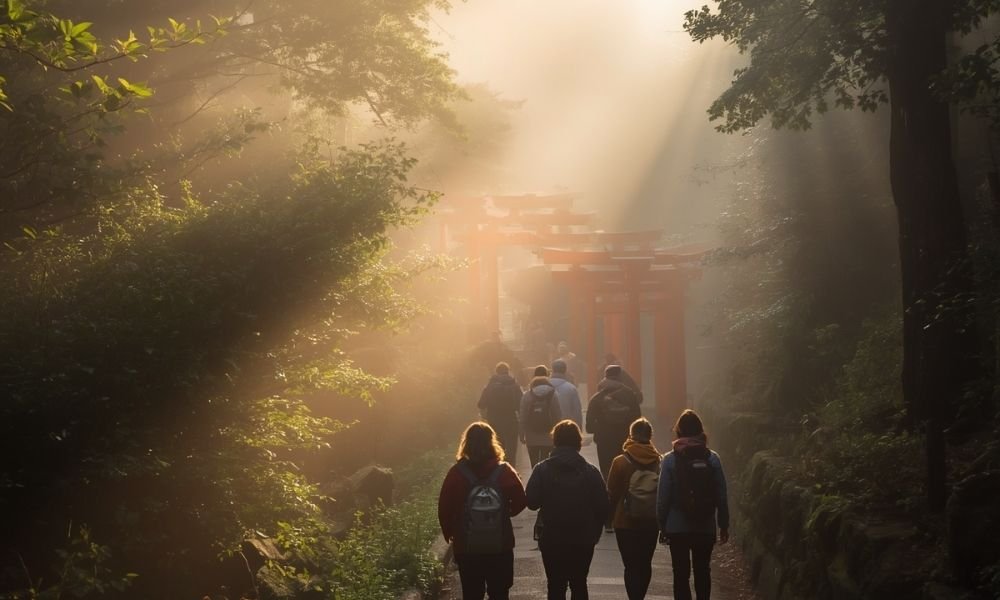
The guide knows the route, the timing, the sub-shrines worth a detour, and which sections of the upper path catch the best early light before it hits the lower gate tunnels. For solo travelers in particular, having someone else handle orientation before 6am is a reasonable thing to pay for.
A guide also carries the kind of knowledge about the shrine’s history, the fox iconography, the meaning of the donated gates, and the etiquette around the smaller sub-shrines that takes years to accumulate. You can read some of this in advance, and reading this article is a start. But hearing it explained while standing in front of the thing it describes is a different experience.
Guided tours also tend to combine Fushimi Inari efficiently with other parts of the day. A morning that starts at the shrine at 5:30am and wraps by 8am leaves you with a full day in Kyoto, and a guide who knows the city’s rhythm can sequence the rest of it better than most people can plan from a hotel room the night before.
A few options that are well-reviewed and worth comparing:
- Early Morning Fushimi Inari Shrine: Beat the Crowds on GetYourGuide is one of the longest-running sunrise options, meeting at the shrine entrance before the day tours arrive and walking the upper paths while they are still clear.
- Fushimi Inari Hidden Trails Hiking Tour takes quieter forest routes away from the main torii tunnel for visitors who want the mountain without the photographic bottleneck.
- Fushimi Inari and Gion Evening Walk Combination on Viator pairs the shrine with a Gion evening walk, a useful structure if you want both in one day without the planning overhead.
Morning slots for sunrise tours book out well ahead during cherry blossom and autumn foliage season. Checking availability a few days before you need it, rather than the night before, is worth the small effort.
What to Bring and What to Expect on the Trail
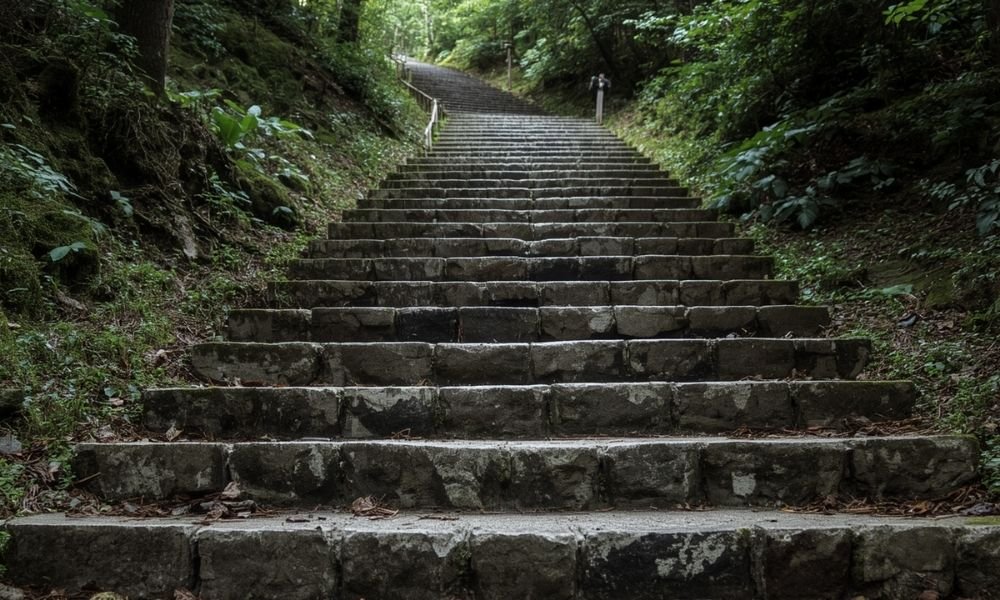
The walk from the base to the Yotsutsuji intersection takes most people 25 to 35 minutes at a steady pace. The full loop to the summit and back runs two to three hours depending on how much time you spend at the sub-shrines along the way. The upper sections of the trail are steeper than the lower paths suggest and involve long stretches of stone steps with irregular spacing.
Wear shoes you have already broken in. Sandals and flat canvas shoes with no grip make the upper sections uncomfortable and genuinely slippery after rain. This is a real hike if you go the full distance, and it is worth treating it like one even if the lower section looks gentle.
Ensure to come with water, although there are some stalls near the base and at the Yotsutsuji intersection, but they open later in the morning. If you are arriving before 7am, the stalls will not be open by then. So, a small bottle from a convenience store near your accommodation or at Kyoto Station can be very help to takes care of this entirely.
The nearest train access is Inari Station on the JR Nara Line, one stop from Kyoto Station and about five minutes by train. The Keihan Line also stops at Fushimi Inari Station, a short walk from the main gate. Both run early enough to get you there for sunrise with no complications.
If it rains, the trail is still walkable and the gates carry a different kind of atmosphere in wet weather. The stone steps do get slippery, which makes the footwear point more rather than less important. The light through the gates in overcast conditions is flat but even, which makes it easier to photograph than the high-contrast midday sun. Some photographers specifically prefer overcast mornings here for that reason.
FAQ
Is Fushimi Inari free?
Yes. There is no admission fee at any point on the trail or at the main shrine. It has been open access throughout its history as a public religious site and this is not expected to change.
Do you need tickets for Fushimi Inari?
No tickets exist and none are required. The shrine operates as open access at all hours with no booking system, no entry restriction, and no capacity limit for general visitors.
What time should I visit Fushimi Inari to avoid crowds?
Before 7am is the most reliable window year-round. The lower gate tunnels are closest to empty between 5am and 7am. After 9am on a weekday, and after 8am on a weekend or during peak season, the first section of the trail becomes noticeably congested.
How long does it take to walk all of Fushimi Inari?
The full loop to the summit and back takes two to three hours at a comfortable pace with stops at sub-shrines along the way. Walking only to the Yotsutsuji intersection, which is where the city view opens up and where most of the crowd drops off, takes about 30 minutes each way from the main gate.
Is Fushimi Inari open 24 hours?
Yes. The outdoor paths and torii gate tunnels are accessible at any hour with no closing time. The inner shrine buildings observe their own hours for formal ceremonies, but the walking trail has no curfew or closing restriction.
If you have decided that a guided sunrise tour is the right move, the GetYourGuide sunrise options for Fushimi Inari and Viator’s Kyoto tour listings are the two most reliable places to compare current availability and read recent reviews.
For a full picture of how Fushimi Inari fits into a Kyoto day alongside Gion and Arashiyama, the best walking tours in Kyoto guide covers all three areas and when a guide adds most. If you are still planning the wider trip, the 3 days in Kyoto itinerary shows how the shrine connects with Nara and Osaka day trips without overloading any single day.
Some links in this post are affiliate links. If you book through them, I may earn a small commission at no extra cost to you. I only recommend tours I would actually book myself.